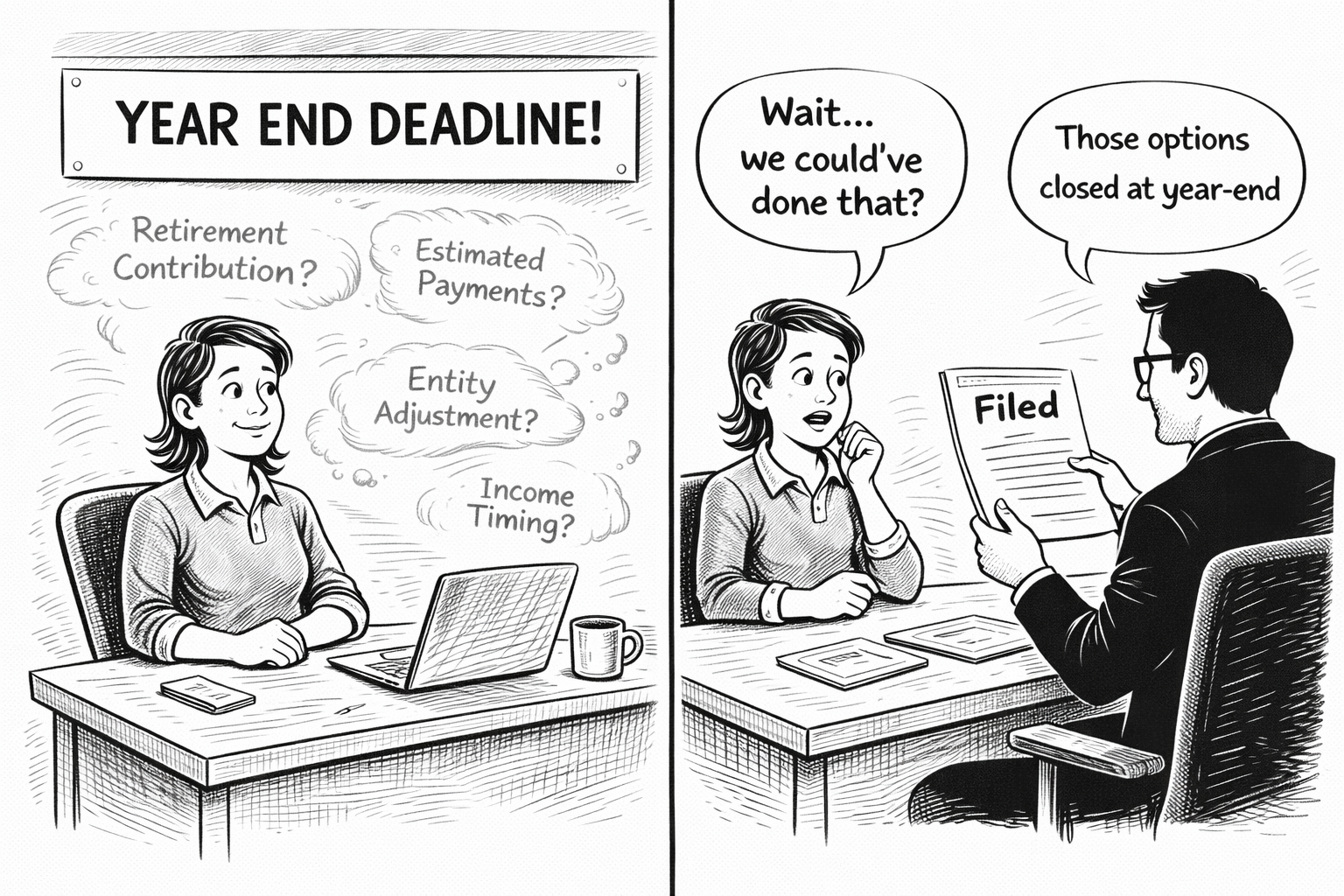
Perception:
As long as I file on time, any bookkeeping issues can be cleaned up at tax season.
Reality:
Structure built throughout the year creates planning opportunities. Cleanup after the fact can only report what already happened.
Olivia considered herself responsible.
She met deadlines.
She kept receipts.
She hired a reputable accountant.
So she wasn’t worried.
Her system was simple.
Operate all year.
Sort it out in March.
Send everything to the accountant.
Problem handled.
Or so she believed.
Each December, her bookkeeping was incomplete. Some transactions were uncategorized. Certain expenses were grouped loosely. A few deposits required explanation.
But she reassured herself:
“My accountant will fix it.”
And the accountant did clean it up.
Reclassified expenses.
Requested missing documentation.
Adjusted totals.
Prepared the return.
Compliance was achieved.
But something critical was missing.
Planning.
Once the calendar year closes, most strategic options close with it.
Income has already been earned.
Expenses have already been incurred.
Entity choices have already been lived.
Compensation decisions have already been made.
An accountant can report history.
He cannot rewrite it.
Olivia assumed cleanup was optimization.
It was not.
Cleanup restores order to what already happened.
Strategy shapes what happens next.
Because her books were not reviewed quarterly, she missed opportunities to:
Adjust estimated payments.
Shift timing of certain expenses.
Evaluate retirement contributions before deadlines.
Revisit compensation structure.
By the time March arrived, the numbers were fixed.
The tax return reflected reality.
But reality had already been locked in.
The calm business owner understands a powerful distinction:
Tax preparation is backward-looking.
Tax planning is forward-looking.
They are not the same service.
They do not occur at the same time.
And they do not produce the same results.
When Olivia began reviewing her financial statements monthly and meeting with her accountant before year-end, the dynamic changed.
Questions became proactive instead of reactive.
Decisions became intentional instead of historical.
Her accountant stopped being a cleanup specialist.
He became a strategic partner.
Year-end is for reporting.
Mid-year is for shaping outcomes.
When business owners believe everything can be fixed at filing time, they delay the very conversations that create leverage.
And that leads directly into the next myth.