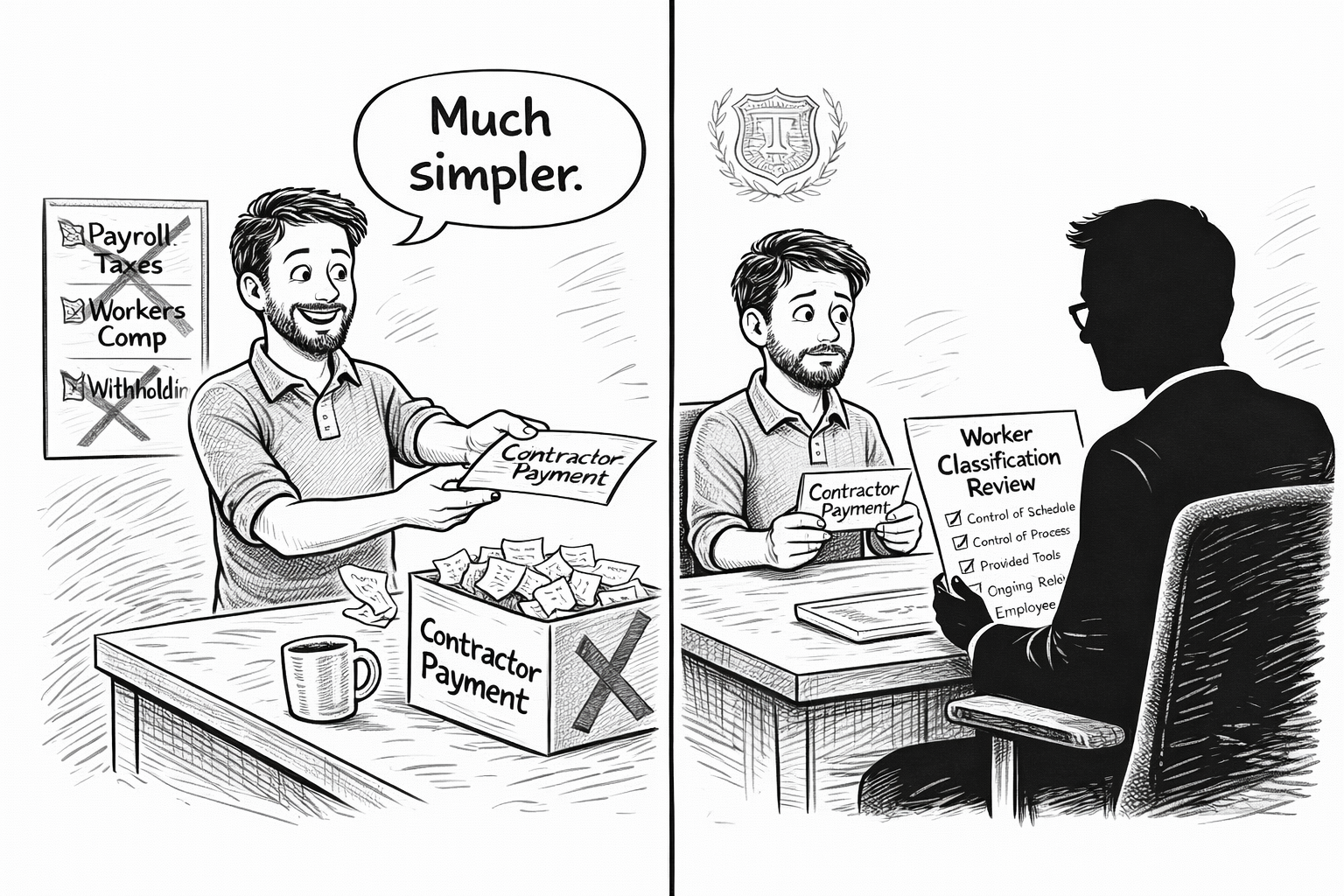
Perception:
I can decide whether someone is an employee or contractor based on what works best for my business.
Reality:
Classification is defined by the nature of the working relationship. Structure determines obligation, not preference.
Marcus was practical.
When his business began growing, he needed help. More hands. More capacity. More output.
Hiring employees felt complicated.
Payroll taxes.
Withholding.
Workers’ compensation.
Unemployment insurance.
So he chose what felt simpler.
“I’ll just pay them as contractors.”
No payroll setup.
No withholding calculations.
Just invoices and payments.
It seemed efficient.
And in the short term, it was.
But classification is not determined by convenience.
It is determined by control.
Marcus set the worker’s schedule.
He dictated how tasks were completed.
He supplied the tools.
He required exclusivity.
The relationship functioned like employment.
But it was labeled as contract work.
The IRS and state agencies evaluate classification using multiple factors, often centered around behavioral control, financial control, and the overall nature of the relationship.
It is not what you call the worker.
It is how the relationship operates.
When classification is incorrect, consequences can include:
Back payroll taxes.
Penalties.
Interest.
Retroactive benefits exposure.
What began as an attempt to “simplify reporting” can become an expensive correction.
Marcus did not intend to misclassify.
He intended to reduce complexity.
But reducing administrative burden does not override legal standards.
The calm business owner understands something critical:
Administrative simplicity is not the same as compliance simplicity.
Before determining classification, he asks:
Who controls the schedule?
Who controls how the work is performed?
Who provides tools and equipment?
Is the relationship ongoing or project-based?
Does the worker operate an independent business serving multiple clients?
These questions define status.
Not preference.
Not cost savings.
Not convenience.
When Marcus adjusted his structure properly, payroll felt more complex.
But his exposure decreased dramatically.
Clarity replaced assumption.
And risk decreased.
Worker classification is not a paperwork decision.
It is a structural one.
And misunderstanding structure leads directly into the next myth.