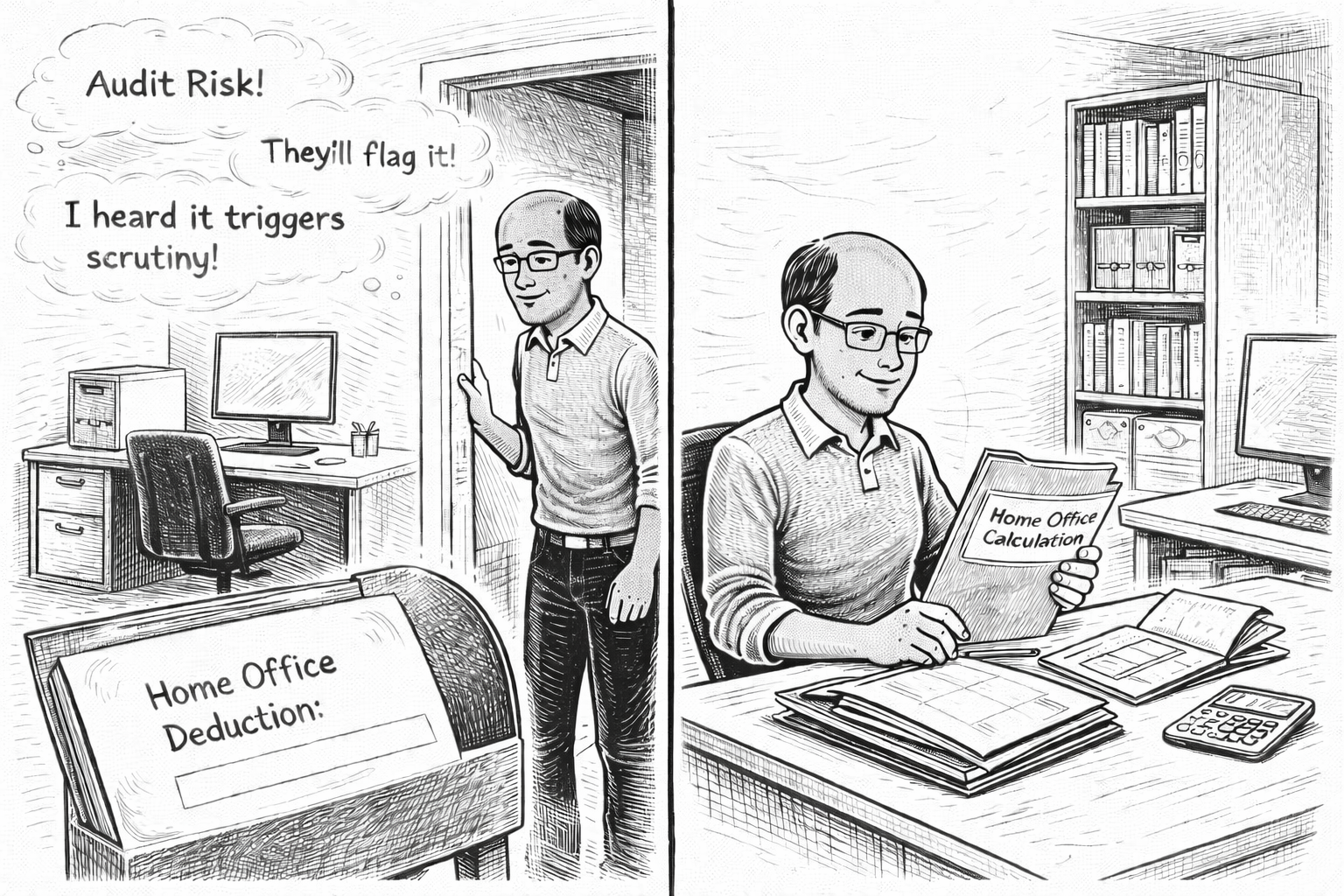
Perception:
If I claim a home office deduction, I’m increasing my chances of being audited.
Reality:
Legitimate deductions, when properly calculated and documented, are part of the tax system. Avoiding valid claims out of fear can result in unnecessary overpayment.
Malcolm had a dedicated office in his home.
A separate room.
A desk.
Equipment.
Files.
It was used exclusively for business.
Yet every year at tax time, he hesitated.
“I’ve heard claiming a home office triggers an audit.”
The warning came from friends. From online forums. From vague stories that never included details.
So Malcolm avoided the deduction.
He absorbed the extra cost quietly.
Year after year.
What he misunderstood was simple.
The IRS does not initiate audits because of a single legitimate deduction.
It evaluates patterns, discrepancies, and statistical anomalies.
A properly calculated home office deduction that meets qualification standards is not suspicious. It is common.
The key word is properly.
To qualify, a home office must generally be used regularly and exclusively for business.
Regularly does not mean occasionally.
Exclusively does not mean primarily.
If the space doubles as a guest bedroom or family area, it likely does not qualify.
If it is clearly separated and used solely for business activity, it often does.
Malcolm’s office met the standards.
But fear overruled facts.
He worried that claiming the deduction would put him on a list.
In reality, failing to claim legitimate deductions does not reduce audit risk.
It increases overpayment.
The calm business owner does not inflate deductions.
He does not avoid legitimate ones either.
He calculates accurately.
He documents clearly.
He maintains reasonable allocations.
Home office deductions can be calculated using simplified methods or actual expense allocations. Both are permitted when applied correctly.
The issue is not the deduction.
The issue is defensibility.
When Malcolm reviewed the requirements carefully and maintained proper documentation, he realized something straightforward.
The deduction exists because many businesses operate from home.
It is built into the system.
Avoiding it out of fear did not reduce risk.
It only increased his tax bill.
Tax myths spread quickly.
Someone hears a story.
Someone repeats it.
Few verify it.
Fear moves faster than facts.
And that fear leads directly into the next myth.