Perception:
The more I write off, the less I pay in taxes.
Reality:
Real and lasting tax savings come from structure, not just chasing deductions.
Carl loved the phrase “It’s a write-off.”
It made almost any purchase feel strategic.
New laptop? Write-off.
Dinner meeting? Write-off.
Conference in another state? Write-off.
Upgraded SUV? Write-off.
One evening over dinner with friends, he proudly said, “It doesn’t really matter. It’s a write-off anyway.”
He felt savvy. Ahead of the game. Like he had discovered a shortcut others had missed.
In his mind, deductions were equivalent to savings.
The logic felt simple:
If I deduct it, I don’t pay tax on it.
If I don’t pay tax on it, I save money.
But that logic was incomplete.
A deduction reduces taxable income.
It does not reimburse the full expense.
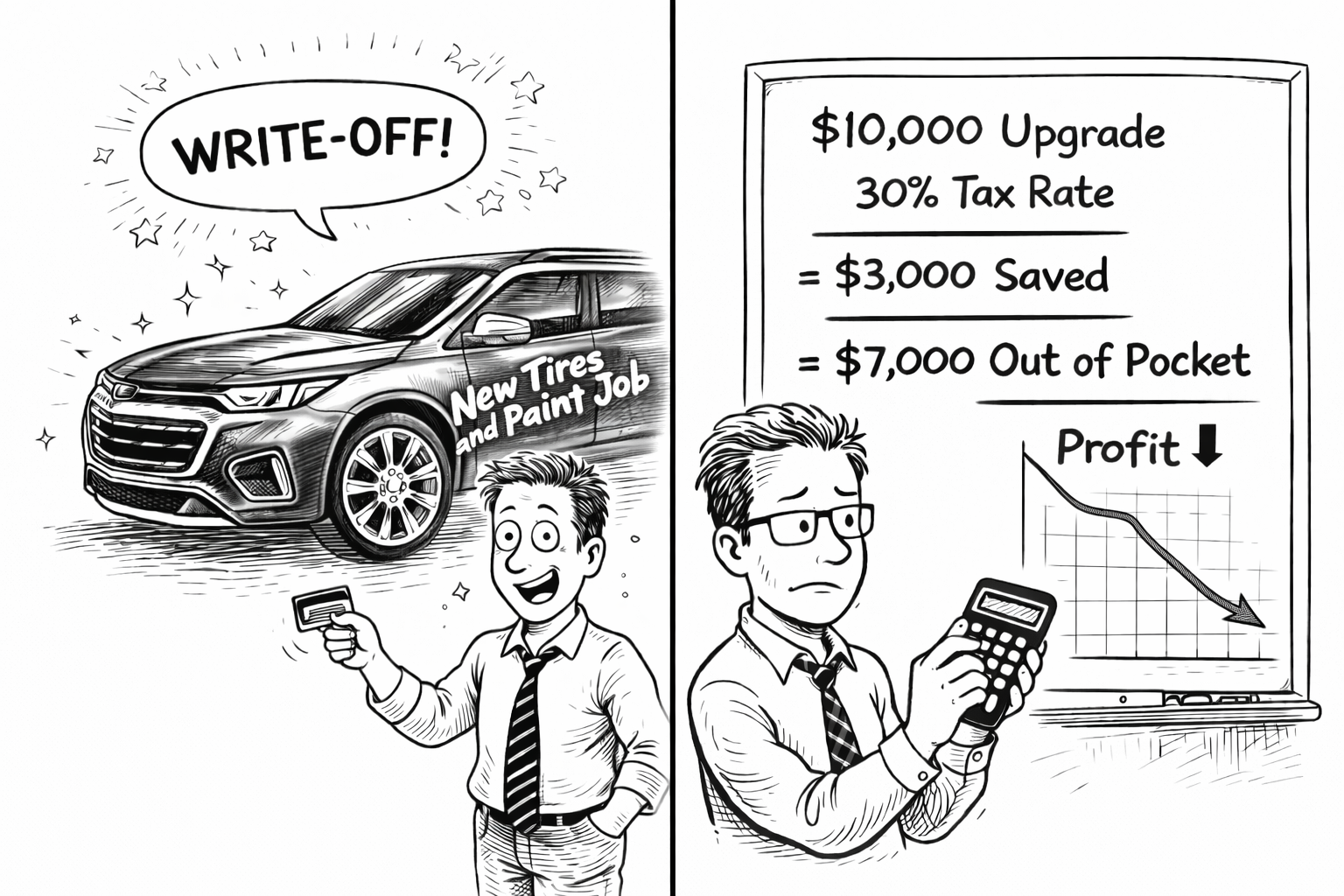
If Carl was in a combined federal and state tax bracket of 30 percent, a $10,000 “write-off” did not save him $10,000.
It saved him $3,000 in taxes.
He still spent $7,000.
Yet he walked away from the purchase feeling like he had “beaten the system.”
This illusion is common.
Business owners begin chasing deductions instead of evaluating profitability.
They justify purchases they might not otherwise make because “it lowers taxes.”
They confuse spending with strategy.
There is nothing wrong with legitimate deductions.
They exist for a reason.
But deductions are reactive.
Structure is proactive.
Carl rarely asked deeper questions:
Should this expense exist at all?
Is it generating revenue?
Is it improving efficiency?
Is there a more tax-efficient way to structure this purchase?
Instead, he focused on accumulating receipts.
By year-end, he had reduced “taxable income” alright.
But he had not necessarily increased net wealth.
The calm business owner understands something critical:
The goal is not to pay the least tax possible.
The goal is to build the strongest business possible within the law.
Those are not always the same thing.
There are only three ways to legitimately improve tax outcomes:
Increase efficiency.
Adjust structure.
Plan in advance.
Chasing deductions is not planning.
It is reacting.
When business owners focus obsessively on “what can I write off,” they often ignore larger structural decisions that create far greater impact:
Entity structure.
Compensation planning.
Timing of income and expenses.
Retirement contributions.
Asset classification.
Small deductions feel satisfying.
Structural decisions change trajectories.
Carl eventually realized that reducing taxable income was not the same as increasing retained earnings.
That realization shifted his mindset from opportunistic to intentional.
Write-offs are tools.
They are not strategy.
And confusing the two fuels the next myth.