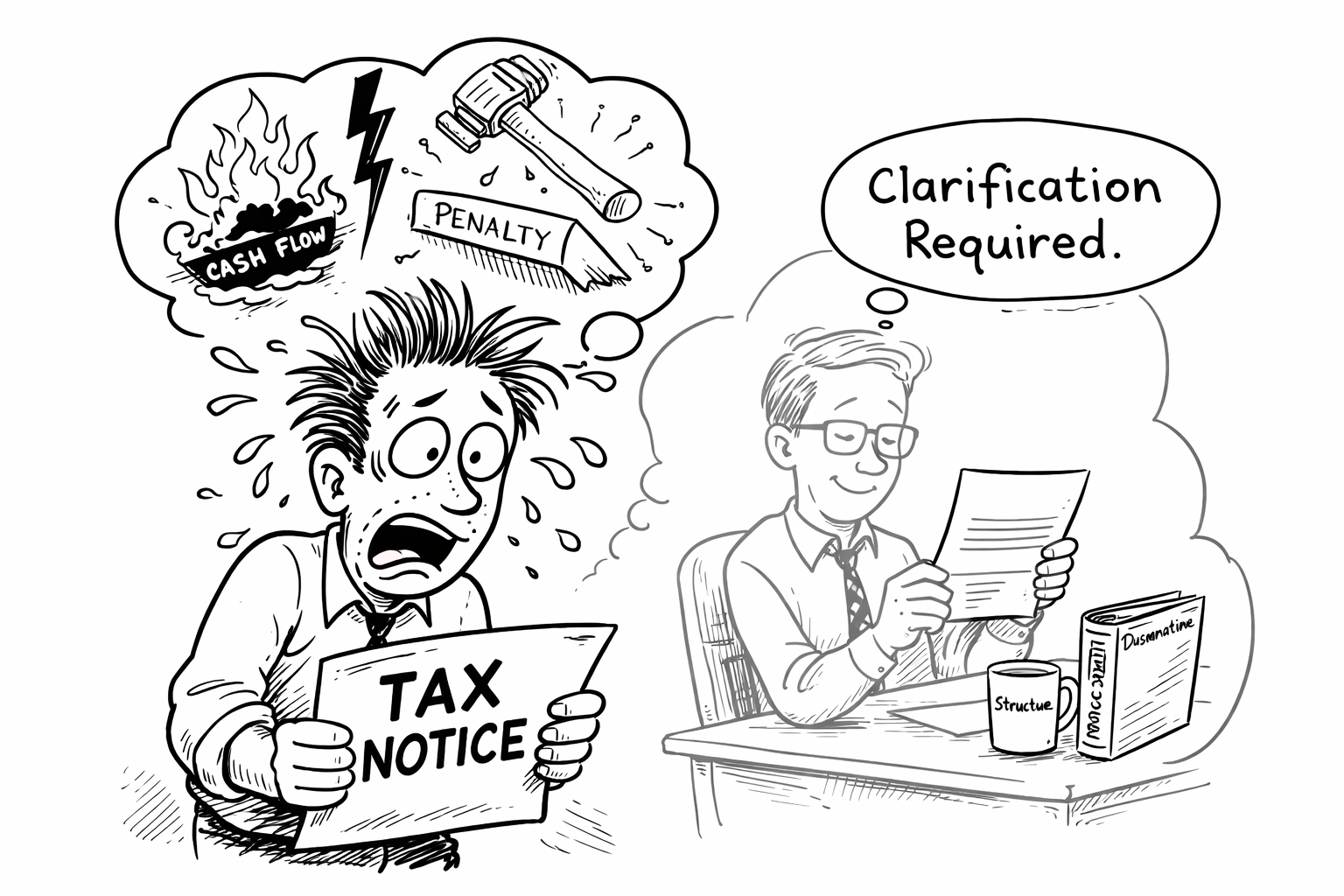
Perception:
If I receive a notice reassessing my return, something has gone terribly wrong.
Reality:
Tax authorities issue notices based on available data. Calm, documented responses often resolve misunderstandings without escalation.
Twelve years ago, as I was going through the day’s mail, one letter glaringly stood out.
It was from the IRS.
Those three letters carry weight…even fear. Most business owners do not open them casually.
And this was not one of the routine notices the IRS sends out.
I quickly scanned the letter.
Then I saw the assessment.
An additional $50,000 in taxes owed.
Fifty thousand dollars!
An extra $50,000 would have severely hurt my cash flow. It would have disrupted operations. It would have forced difficult decisions.
For a brief moment, fear spoke loudly.
Had I missed something?
Was this the beginning of something far worse?
Was I about to enter a battle I was not prepared for?
I put the letter down.
Then I picked it up again and read it slowly, carefully, line by line.
On that second reading, the emotion faded.
And I knew exactly how I needed to respond.
At the time, I was running a music education business that operated very differently from a traditional brick-and-mortar school. I traveled from city to city across the United States, renting hotel meeting rooms and conducting live workshops.
Participants experienced my method firsthand. Those who believed in it enrolled immediately.
Ninety-nine percent of my sales were processed by credit card in those hotel meeting rooms.
The IRS letter explained that based on comparable schools, the average volume of credit card sales in similar businesses was approximately 60 percent. Because I reported nearly all of my revenue through credit cards, they concluded I must be underreporting income.
In other words, my numbers did not match their averages.
But averages do not define reality.
Structure does.
Instead of reacting emotionally, I responded structurally.
I explained the nature of my business model. I documented that I rented hotel meeting rooms across multiple cities and conducted enrollment-based workshops. I provided supporting documentation reflecting how sales were generated and how the business operated. My travel expenses aligned with the structure and scope of that model.
I did not argue.
I clarified.
A few weeks later, another letter arrived.
The IRS accepted my explanation.
No further action was necessary.
The matter was closed.
An IRS notice is not a verdict.
It is a request for clarification based on available data.
Tax systems compare patterns. When numbers fall outside statistical norms, a notice is generated.
Fear interprets the notice as punishment.
Structure recognizes it as procedure.
The calm business owner understands the difference.
Documentation replaces anxiety.
Clarity replaces panic.
Preparation replaces sleepless nights.
Most business owners never move past the fear stage.
And that fear fuels the next myth.