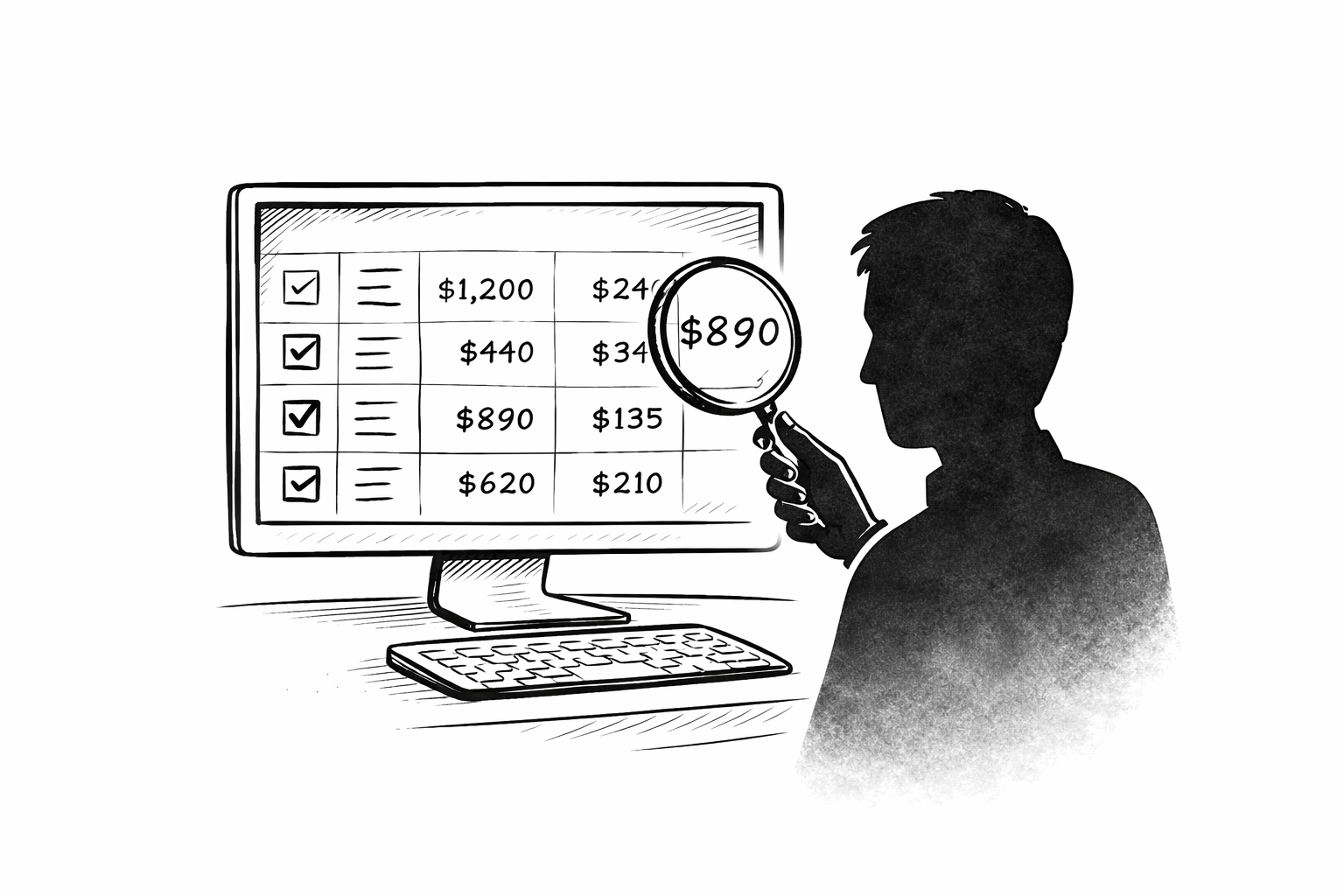
Laura loved her bookkeeping software.
It connected to her bank. It pulled in transactions automatically. It suggested categories with reassuring little checkmarks. Most months, she barely touched a thing. Everything looked neat. Balanced. Professional.
She felt organized. Responsible. Ahead of the game.
And in a way, she was.
The trouble showed up quietly.
When tax time arrived, the reports looked clean but raised more questions than answers. Categories were consistent, but consistently vague. Similar expenses landed in different places. Charges from the same vendor meant different things on different days, but the software treated them as identical.
Laura assumed this was normal. After all, the software was doing exactly what it promised. It captured data efficiently.
What it could not do was understand intent.
Software does not know why money was spent. It does not know whether a transaction was personal, business-related, unusual, or one-time. It recognizes patterns, not meaning. And when meaning is missing, clarity disappears.
This is where many business owners get lulled into a false sense of security.
If the numbers add up, the thinking goes, everything must be fine.
But clean-looking books are not the same thing as clear books.
This is also where excitement about automation and artificial intelligence can get ahead of reality. Software and AI are powerful tools. They are fast. They are consistent. They are tireless.
But they do not replace understanding.
That is why software, and even AI, will never replace human insight. With tax-ready work, the human edge is never taken out of the equation.
Judgment still matters. Context still matters. Someone still has to notice when a category makes sense on paper but creates confusion in real life. Someone still has to decide when a transaction needs a note instead of a guess.
Tax-ready books require thinking, not just processing.
When software is used without oversight, small assumptions compound. A guess here. A shortcut there. Nothing dramatic. Just enough ambiguity to slow everything down later, when it matters most.
The businesses that feel calm at tax time are not the ones with the most features turned on. They are the ones who understand the role software is meant to play.
They treat it as a starting point, not a solution.
They use automation to save time, and human judgment to create clarity.
Software records transactions.
People create tax-ready books.
Once you see that distinction clearly, you stop expecting technology to do a job it was never meant to do. And you start using it the way it actually works best.
As a tool.
Guided by human insight.