About the Book, the Author and Important Notice
Back to Table of ContentsWhy This Book Matters
Most small business owners don’t think about their books all year.
They think about them at tax time.
That’s when the questions surface.
That’s when uncertainty sets in.
That’s when stress replaces confidence.
And for most, that stress isn’t caused by anything dramatic or dishonest.
It’s caused by something far more common:
decisions made without clarity
records built on assumptions
systems that worked well enough until they were put under pressure
Because the moment your numbers are relied upon for tax filing, for advice, or for financial decisions, good enough stops being good enough.
This book was written to change that.
Most businesses don’t have a tax problem.
They have a record structure problem.
Think of a building with a strong foundation.
Even if repairs or adjustments are needed on the upper floors, the structure holds. The work is manageable.
But when the foundation itself is unstable, every adjustment above it introduces more risk. What looks like a fix can make the situation worse.
That’s exactly how most bookkeeping problems develop.
When your books are unclear, inconsistent, or incomplete, everything downstream weakens:
deductions are missed or unsupported
tax filings become reactive instead of intentional
outcomes become uncertain
Tax-ready books operate differently.
They are built with clarity.
They are maintained with consistency.
And they are structured to support accurate, defensible, and favorable tax outcomes.
That’s what this book shows you.
Each chapter walks through real-world situations that reveal where things tend to break down, not in theory, but in practice.
You’ll see why:
software alone doesn’t solve the problem
waiting until tax time creates unnecessary pressure
guessing introduces more risk than leaving something clearly unresolved
over-optimization weakens your position instead of strengthening it
consistency outperforms effort every time
and why clean books always cost less in the long run
These are not isolated mistakes. They are patterns.
And once you see them, you begin to understand something important:
Tax outcomes are not determined at the end of the year.
They are shaped throughout the year, one decision, one classification, one habit at a time.
Then comes Chapter 12.
For many readers, that’s where the shift happens.
Because it becomes clear that this is not just about tax preparation.
It is about control.
Clear, structured books allow you to:
allocate resources with confidence
present your business clearly to lenders or investors
position your business for a stronger, more valuable exit
Even if you never plan to sell.
Even if you never seek outside capital.
Because businesses with clear records always have more options than those without.
This book does not ask you to do everything.
It shows you how to do the right few things, consistently, and with intention.
If you have ever felt uneasy handing your books to someone else
If you have ever questioned whether your numbers truly reflect your business
If you want tax time to feel controlled instead of chaotic
This book was written for you.
Read it straight through.
Or take it one chapter at a time.
Either way, by the end, you will see your books differently.
And once that happens, everything else begins to fall into place.
About This Book
This book is written for small business owners who do their best all year and still feel a knot in their stomach when tax time approaches.
Not because they have done something wrong.
Because they are not fully confident in what their records actually say.
This book is a clear, practical guide to what tax-ready really means and why so many books fall short of that standard.
Most bookkeeping systems are built to record activity.
Tax-ready systems are built to support outcomes.
That difference changes everything.
When your records are structured correctly:
your numbers make sense
your reports can be relied upon
your tax filing becomes a process instead of a problem
This book shows you how that happens.
If you prepare your own records, it will help you build books that are clear, consistent, and usable.
If you work with a tax professional, it will help you provide information that supports better results and fewer questions.
Either way, the goal is the same:
To ensure that the story your books tell is accurate, complete, and strong enough to stand on its own.
Who This Book Is For
This book is written for service-based small business owners who want clarity instead of confusion when it comes to their financial records.
It is for those who are already putting in the effort, using software, keeping track of transactions, and trying to stay organized, but still feel uncertain about whether their books are truly solid.
It is for owners who understand that clean records are not just about staying compliant, but about having a clear, reliable picture of their business.
You will benefit from this book if you:
want to approach tax time with confidence instead of hesitation
use bookkeeping software but are not fully confident in how it is being used
want your records to hold up under scrutiny, not just look right on the surface
prefer clear, consistent systems over last-minute fixes
understand that strong financial records support better decisions throughout the year
This book is not built for complex, multi-entity operations or highly specialized industries with unique reporting requirements. They have entire departments focused on doing this for them.
It is written for the small business professional who owns a service-based entity and wants a clear, structured, and reliable foundation for their financial records
About the Author

A Personal Note
For many years, my work and life spanned two countries. That meant filing multiple returns every year. Personal and corporate. Canada and the United States. Four filings, every cycle.
I worked with professionals. Capable, experienced, and highly recommended. And yet, year after year, there was a quiet unease. I never felt fully confident in how my records were prepared or understood. I signed where I was told to sign, paid what I was told to pay, and moved on.
Until one year, something didn’t get filed.
Most likely out of overload. Too many clients. Too little time. But that moment made something clear.
Responsibility for my records rested with me.
So I stepped in and learned.
I wanted to understand how my own records worked and how information flowed into a return.
What I found changed everything.
When the records were clear, the results were clear. The numbers made sense. The filings reflected that clarity. And for the first time, I felt at peace with what I was signing.
That experience reshaped how I think about bookkeeping.
Clean records are not about "beating the system." They are about understanding your business well enough to stand confidently behind the numbers.
Clear records don’t cross lines or sidestep boundaries. They are about good business sense.
And that leads to better, more favorable tax outcomes.
This book is built on that.
Important Notice
The examples in this book are composites drawn from common situations. Names, details, and timelines are fictionalized to protect privacy. Any resemblance to real persons or businesses is coincidental.
Chapter 1: What Tax Ready Means
Back to Table of Contents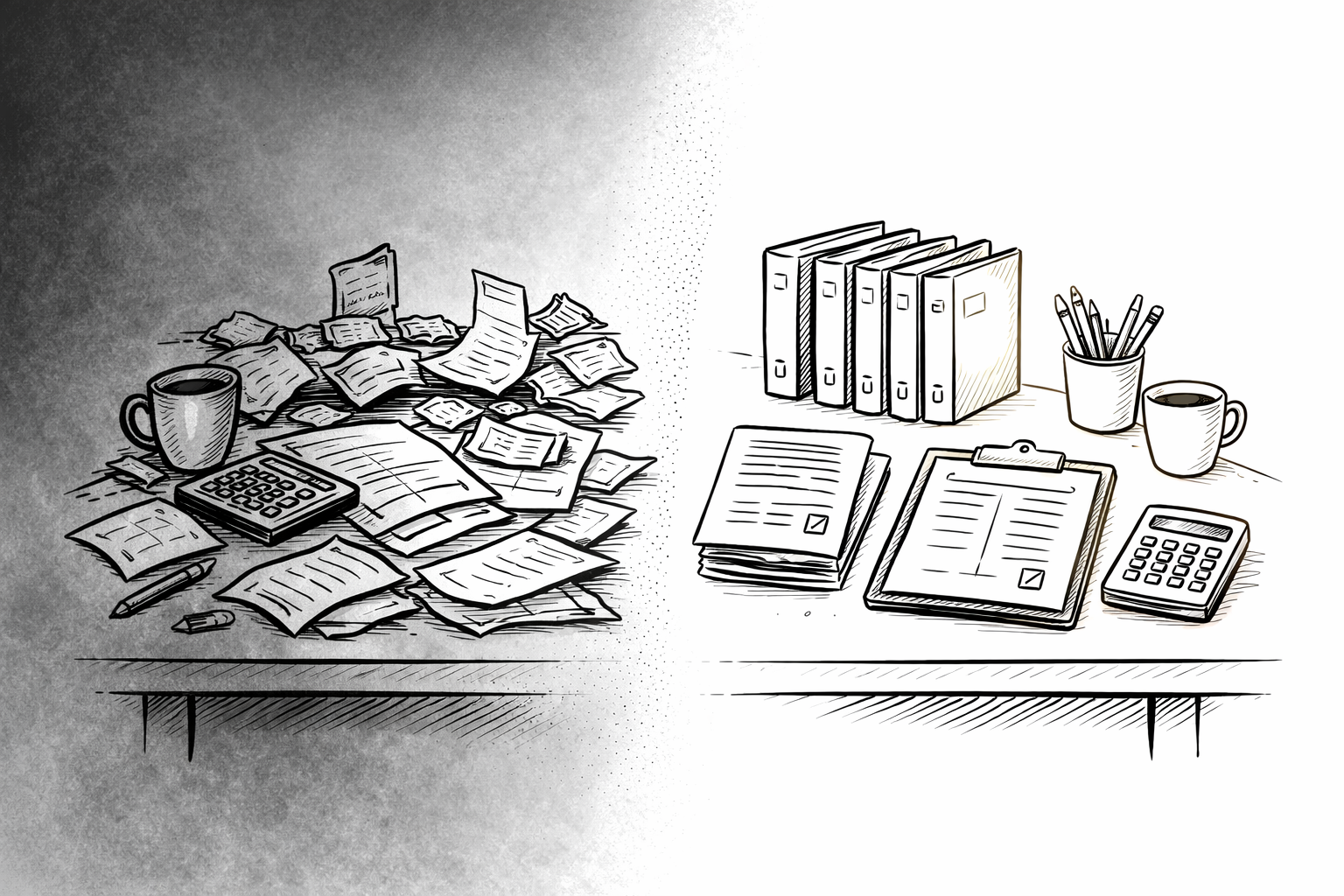
You’re doing the work. The money is coming in. So why does tax time still feel off? This chapter reveals what’s missing.
Mickey ran a small service business that stayed busy most of the year.
Clients paid on time. Bills got covered. There was usually enough left over to feel like the business was doing what it was supposed to do.
From the outside, everything looked fine.
Then tax time arrived.
Like most business owners, Mickey followed the same routine every year. He gathered his bank statements, credit card summaries, and whatever reports his software could produce. He organized everything into a folder, sent it off, and waited.
From his point of view, everything was there. Nothing was missing. That meant he was tax ready.
It didn’t.
The questions came back every time.
What was this charge in April?
Why did this category increase in August?
Was this personal or business?
Was that expense tied to a client or something else?
Each answer depended on memory. And memory fails when it matters most.
Mickey wasn’t careless. He was operating under a common assumption.
If the information exists somewhere, someone else can sort it out.
That assumption quietly costs business owners money every year.
Tax Ready Does Not Mean Complete
Most business owners think tax ready means everything is gathered.
That is not tax ready. That is documentation.
Tax ready means your records are structured in a way that produces a clear, consistent, and defensible financial story.
Tax outcomes are based on what is clearly presented, properly classified, and supported.
Structure Determines Outcome
Think of your records as the foundation of a building.
When the foundation is strong, adjustments are manageable.
When it is unstable, every adjustment introduces risk.
That is exactly what happens when books are unclear.
Why Most Businesses Overpay
Most businesses do not overpay taxes because they “lack” deductions.
The deductions are there.
In fact, the IRS recognizes over a thousand legitimate deductions. I cover those in detail in my book The Tax Deduction Detective.
The problem is not availability.
It is structure.
If your records are not built to support those deductions, you cannot use them.
And if you cannot use them, you lose them.
When transactions are unclear:
expenses get categorized incorrectly
legitimate deductions get missed
or worse, they are not used because they cannot be defended
No one plans to lose money.
But without a plan, that is exactly what happens.
Quietly.
Consistently.
Year after year.
The Three Questions That Control Everything
Tax ready books answer three questions without hesitation:
What money came in
What money went out
Why each transaction belongs where it does
Clarity Creates Leverage
When your records are clear, your numbers make sense, your reports can be trusted, and your tax position becomes stronger.
Tax outcomes are shaped throughout the year through how transactions are handled and classified.
Tax Ready Is a System
Tax ready is not something you assemble at the end of the year.
It is a system you maintain throughout the year.
When that system is in place, your records hold up and your outcomes improve.
What This Really Means for You
You work hard for your income.
What you keep is determined by how well your records support your position.
Clear, structured books ensure you are not leaving money on the table.
That’s the difference.
Chapter 2: Why Software Alone Doesn’t Save You
Back to Table of Contents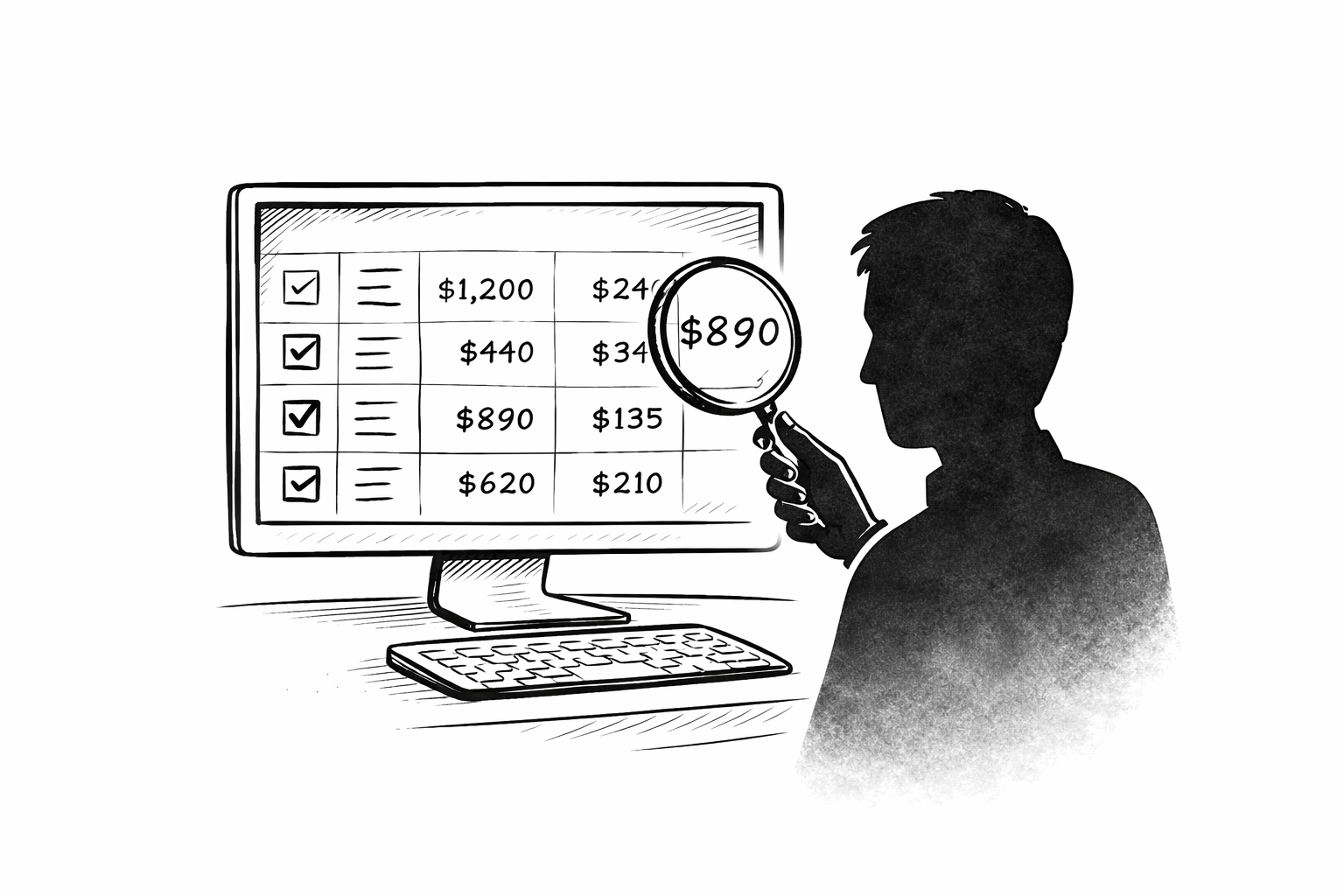
You trust the system. It looks clean. It feels organized. But something isn’t adding up. This chapter explains why.
Laura loved her bookkeeping software.
It connected to her bank.
It pulled in transactions automatically.
It suggested categories with reassuring checkmarks.
Most months, she barely touched a thing.
Everything looked neat.
Balanced.
Professional.
She felt organized.
Responsible.
Ahead of the game.
And in a way, she was.
Then tax time arrived.
The reports looked clean.
But they raised more questions than answers.
Categories were consistent, but consistently vague.
Similar expenses showed up in different places.
The same vendor meant different things on different days, but the software treated them as identical.
From the outside, everything looked right.
Underneath, nothing was clear.
The Illusion of Clean Books
This is where most business owners get misled.
If the numbers add up, everything must be fine.
If the reports look professional, everything must be accurate.
If the software is working, the books must be solid.
None of that is true.
Clean-looking books are not the same as clear books.
And unclear books lead to weak tax outcomes.
What Software Actually Does
Software is designed to capture and organize data.
It is fast.
It is consistent.
It is efficient.
But it does not understand intent.
It does not know:
why money was spent
whether a transaction was personal or business
whether something was routine or one-time
how a decision today affects your tax position later
It recognizes patterns.
It does not create meaning.
And when meaning is missing, clarity disappears.
Where the Money Gets Lost
This is not a technical issue.
It is a financial one.
When software is left to run without oversight:
transactions get categorized based on patterns, not purpose
small inconsistencies build over time
legitimate deductions lose clarity
and unclear items are either misused or avoided altogether
No one makes a single large mistake.
It happens in small decisions.
A guess here.
An automatic category there.
Nothing that feels significant in the moment.
But by the end of the year, those small gaps add up.
And when your records cannot clearly support a position, you lose the ability to use it.
Automation Is a Tool, Not a System
There is a growing belief that automation and AI can replace human judgment.
They cannot.
They can speed up the process.
They can improve consistency.
But they cannot make decisions with context.
Tax-ready work depends on:
judgment
context
intent
and consistency over time
Those are human functions.
Not software features.
The Businesses That Get It Right
The businesses that feel calm at tax time are not the ones using the most advanced tools.
They are the ones who understand how those tools are meant to be used.
They use software to capture data.
Then they apply human judgment to that data.
They do not rely on automation to decide what something means.
They make that decision themselves.
And that decision is what drives the outcome.
The Line That Matters
Software records transactions.
People determine what those transactions mean.
And meaning is what determines your tax outcome.
What This Means for You
If you rely on software alone, your books will look clean.
But they will not be structured.
And without that, all you have are pretty books that still leave a lot of your hard-earned dollars on the table.
Not because the deductions are not there.
Because your records do not support using them.
Don’t get me wrong, software is a useful and helpful tool.
But a tool does not replace strategic thinking.
It never will.
Chapter 3: The Myth of “I’ll Just Sort It at Tax Time”
Back to Table of Contents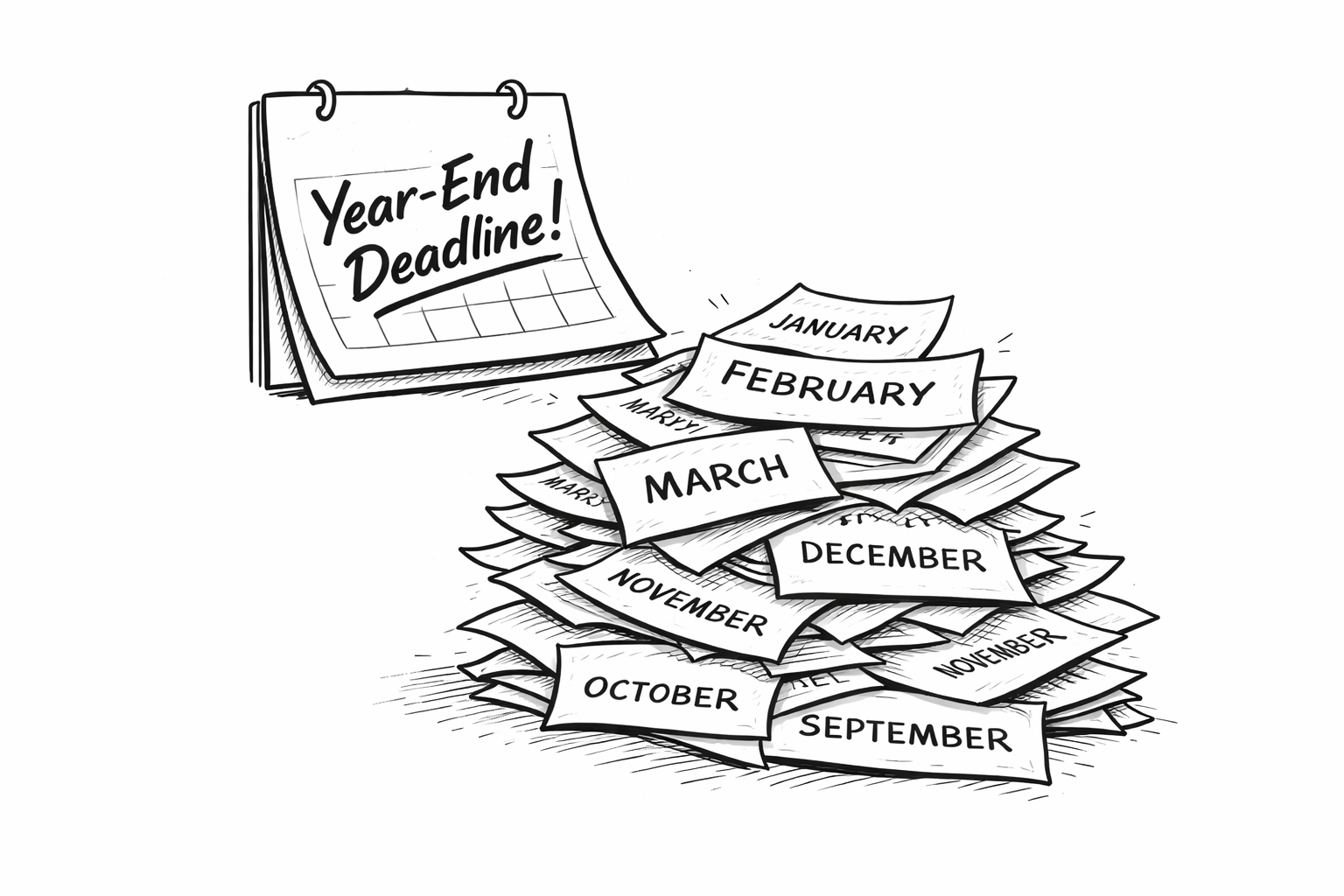
You meant to stay on top of it. Life got busy. Now it’s all waiting for you and it’s heavier and more stressful than you expected.
Every year, Kevin told himself the same thing.
“I’ll deal with it later.”
Kevin ran a growing service business. He was good at what he did. Busy most days. Work kept coming in, and that felt like progress.
Bookkeeping was not ignored.
It was postponed.
When a transaction came through that he did not immediately recognize, he moved on.
He would remember later.
When receipts piled up in his inbox, he flagged them.
Later.
When a category felt close enough, he made a quick decision and kept going.
Close enough was good enough.
For now.
Tax time was when everything would get sorted properly.
At least, that was the plan.
When “Later” Finally Arrives
By the time March rolled around, later had arrived.
And it did not feel flexible anymore.
It felt heavy.
Kevin sat down with a year’s worth of transactions and realized something uncomfortable.
What once felt obvious… wasn’t.
That charge from early spring looked familiar.
But the reason behind it was gone.
A group of expenses from summer blurred together.
A few larger transactions stood out, but the details that made them useful had disappeared.
Now he was staring at numbers, trying to reconstruct decisions he had made months earlier.
From memory.
And memory is a fragile system when money is on the line.
Here’s Where It Starts to Break Down
So he did what most business owners do at that point.
He tried to rebuild the story.
He opened old emails.
He searched his calendar.
He retraced steps.
And when the answer did not show up?
He guessed.
More often than he wanted to admit.
What should have taken minutes… took hours.
What should have been clear… became uncertain.
What should have been simple… became exhausting.
The Hidden Cost of “I’ll Do It Later”
This is the myth.
That sorting later is easier than deciding now.
In the moment, it feels efficient.
It feels flexible.
It feels harmless.
But later is not neutral.
Later is expensive.
Because when information fades:
decisions become guesses
guesses weaken your position
and weak positions cost you dollars
Not all at once.
But enough to matter.
Why This Quietly Hits You in the Wallet
This is where most business owners miss what is really happening.
They think the cost is time.
It is not.
The real cost shows up in what you cannot confidently claim.
When you are unsure:
you hesitate
you avoid using things you could have used
or you accept whatever outcome comes back without question
Not because you want to.
Because you do not have the support to do anything else.
That is how money gets left on the table.
Not through big mistakes.
Through small moments of uncertainty.
Timing Is Everything
Tax-ready work is not about doing everything perfectly in real time.
It is about doing enough while the information still makes sense.
A short note today removes a long guessing session later.
A quick decision now prevents a stressful one under pressure.
Small actions.
Taken consistently.
That is what changes the outcome.
Reconstruction Is Extremely Stressful
Sorting everything at tax time turns bookkeeping into reconstruction.
You are looking backward.
Trying to piece together intent.
Hoping the details are still there.
Sometimes they are.
Often, they are not.
And when they are not, the quality of your decisions drops.
And when the quality drops, so do your outcomes.
“I’ll just sort it later” sounds reasonable.
Until later arrives.
And when it does, you are no longer organizing.
You are recovering.
And recovery is always harder than getting it right the first time.
Feel Relaxed and Confident at Tax Time
The businesses that feel calm at tax time are not the ones who worked hardest in March.
They are the ones who made fewer decisions under pressure.
They handled things while they were still clear.
While the details were still fresh.
While the reasoning still made sense.
That’s the difference!
What This Means for You
If this feels familiar, you are not alone.
Most business owners operate this way at some point.
But now you see the trade off.
You are not saving time.
You are shifting the burden.
And when that burden comes back, it brings uncertainty with it.
Tax-ready books remove that moment entirely.
They are not built on memory.
They are built on decisions made while things are still clear.
And that changes everything.
Note: For a deeper dive into "tax myths”, check out my book, Tax Myths Exploded.
Chapter 4: Mixed Personal and Business: The Silent Killer
Back to Table of Contents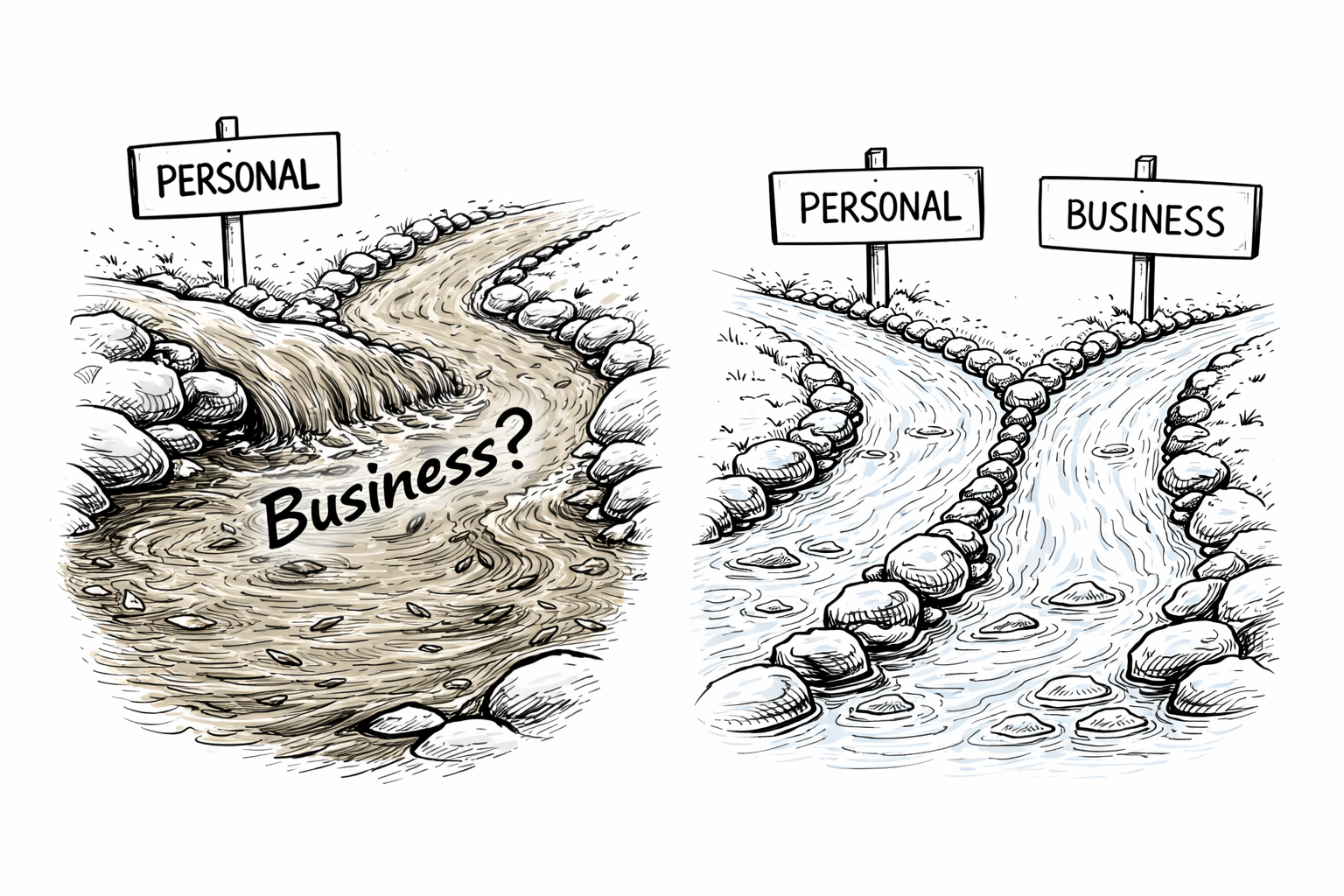
Mixing personal and business spending feels simple. It’s one of the most expensive mistakes you can make. But once you fix it, the good news is you may uncover hidden gems that give you tax-free money.
Angela ran her business out of the same account she used for everyday life.
Groceries.
Gas.
Client payments.
Subscriptions.
Dinner with friends.
A new laptop.
It all flowed through one place.
To her, it felt efficient.
One login.
One statement.
One less thing to manage.
And for a while, it worked.
Or at least, it felt like it did.
Where the Problem Actually Starts
The problem with mixed accounts is not that they break immediately.
It’s that they fail quietly.
Month after month.
Transaction after transaction.
Clarity slips just a little at a time.
Nothing feels urgent.
Nothing feels wrong.
Until it matters.
Every Transaction Becomes a Question
When business and personal spending live together, every transaction becomes a question waiting to be answered later.
Not today.
Later.
And later is where problems grow.
At first, it’s obvious.
That was business.
That was personal.
No confusion.
But time changes that.
A charge at a familiar store could be either.
A payment could relate to work.
Or it might not.
And the certainty you had in the moment?
It fades faster than you expect.
When Certainty Disappears, Guessing Takes Over
Once certainty is gone, guesswork steps in.
And guesswork is where money starts slipping away.
Because when you are unsure:
you hesitate
you second-guess your decisions
you avoid claiming things you could have claimed
Not because they are not valid.
Because you cannot clearly support them.
Why This Hits You Financially
This is one of the most common ways business owners lose money.
Not through big mistakes.
Through small moments of uncertainty.
Mixed accounts force you to explain everything.
And when everything needs explaining, nothing feels solid.
So what happens?
You take the safer route.
You leave things out.
You accept less than you could have claimed.
And over time…
That adds up.
Memory Is Not a System
Most business owners do not mix accounts because they are careless.
They do it because it feels simple.
Convenient.
Efficient.
But what they are really doing is creating a system that depends on memory.
And memory fails under pressure.
Tax time is pressure.
And pressure exposes weak systems.
The Cost of “Keeping It Simple”
One account feels easier.
Until you have to explain it.
Then it becomes work.
Extra work.
Stressful work.
Expensive work.
Because what looked simple in the moment becomes complicated later.
And that complication costs you.
What Serene Businesses Do Differently
The businesses that feel calm at tax time do one thing consistently.
They separate.
Business activity stays in business accounts.
Personal spending stays personal.
The line is clear.
And because the line is clear:
transactions make sense
patterns show up naturally
decisions become easier
and records support themselves
No guessing.
No explaining everything.
No second-guessing.
Why Simplicity Wins
There is nothing exciting about separation.
It is simple.
Predictable.
Even a little boring.
But that simplicity is powerful.
Because it removes confusion before it starts.
How This Quietly Breaks Things
Mixed accounts do not fail loudly.
They fail slowly.
They introduce:
doubt
extra questions
unnecessary work
Into a process that depends on certainty.
And once doubt is in the system, everything becomes harder.
What This Means for You
If your business and personal spending run through the same account, you already know what this feels like.
You’ve looked at a transaction and paused.
You’ve wondered, “What was that for?”
You’ve guessed.
You’ve moved on.
That moment matters more than it seems.
Because enough of those moments…
And your numbers stop working for you.
Separation fixes that.
It gives your records a clear story.
And clear records give you confidence.
The Bottom Line
Remember, clear records lead to better, more favorable tax outcomes.
If you’ve been mixing your personal and business spending, your first step is to separate them as soon as possible.
The moment you do, something interesting happens.
You begin to see what was hidden.
Expenses that were missed.
Payments that were never properly accounted for.
Money you put into the business that never came back to you.
In many cases, that’s money you can legitimately recover.
Tax free.
Money that was always yours… just buried in the noise.
And once it’s visible, you can take action on it.
If you want help cleaning that up and getting it right going forward, we can help you do that properly.
Chapter 5: Categories That Sound Right but Cause Problems
Back to Table of Contents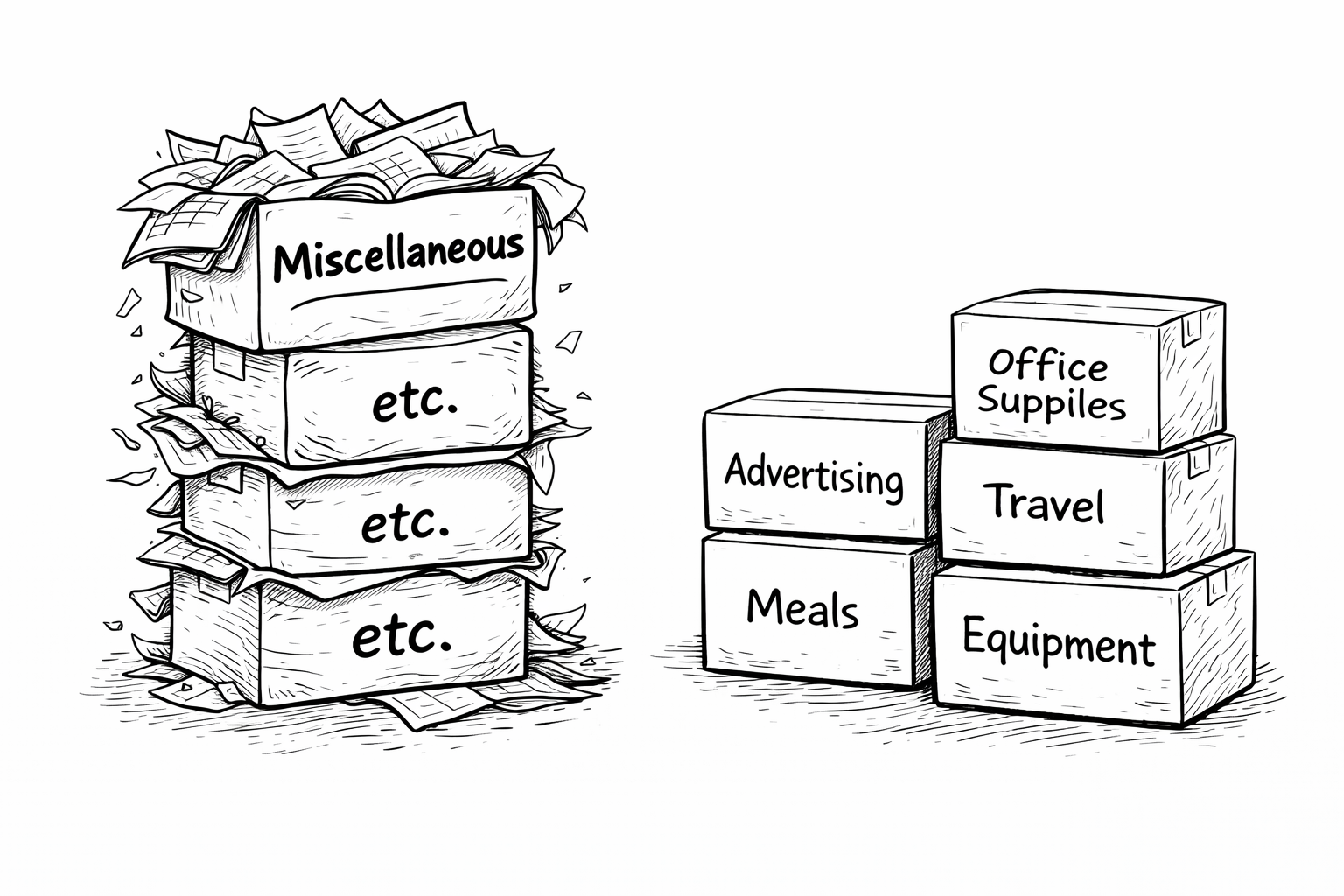
Your books look organized. But they’re not telling you the whole truth. This chapter shows you what’s getting lost.
Brian liked things to feel tidy.
When he set up his books, he chose labels that sounded sensible.
“General Expenses.”
“Miscellaneous.”
A few broad buckets that could hold just about anything.
It felt practical.
Nothing had to slow him down.
If something didn’t fit perfectly, it still had a place.
And that made things easy.
When “Easy” Becomes Invisible
At first, everything looked clean.
Transactions were recorded.
Reports were generated.
Nothing stood out as a problem.
But over time, something started to disappear.
Detail.
Different types of spending began landing in the same place.
Patterns faded.
Important distinctions got buried.
And the reports?
They still looked organized.
They just stopped saying anything useful.
Nothing Looks Wrong… That’s the Problem
This is where most business owners get caught.
If nothing looks broken, everything must be fine.
But broad, catch-all labels don’t break.
They blur.
They hide what actually matters.
And because nothing looks obviously wrong, the issue goes unnoticed.
Until it matters.
Where the Money Starts Slipping
When too many things get grouped together:
real expenses lose their meaning
useful patterns disappear
and decisions become harder to make
You stop seeing where money is actually going.
You only see where it was placed.
And those are not the same thing.
Why This Costs You at Tax Time
This is where it hits.
When your records don’t clearly show what something is:
you hesitate
you second-guess
or you default to the safer option
Not because you have to.
Because you can’t confidently do anything else.
So what happens?
You leave things as they are.
You don’t push for better treatment.
You accept less than you could have.
And once again…
Money gets left on the table.
What Actually Works
Good categorization is not about having more labels.
It’s about having the right ones.
Ones that reflect how your business actually operates.
Ones that mean the same thing every time you use them.
Ones that still make sense months later, not just in the moment.
Because if you have to explain it later…
You’ve already lost something.
The Six-Month Test
Here’s a simple way to know if something is working.
If you looked at that label six months from now…
Would you immediately know what belongs there?
Or would you have to stop and think?
If you have to think, it’s already working against you.
What This Turns Into Later
At some point, someone has to look at your records and understand them.
That might be you.
It might be someone helping you.
But either way, the question becomes:
“What’s actually inside this?”
And now instead of moving forward…
You’re unpacking.
Digging through transactions.
Trying to figure out what you meant at the time.
That takes time.
And time is not the real cost.
Confusion Always Has a Price
When things are unclear:
decisions slow down
confidence drops
and opportunities get missed
Confusion is never neutral.
Someone always pays for it.
And more often than not…
That someone is you.
What This Means for You
If you’ve ever used a label just because it was “close enough,” you already understand this.
It saved you time in the moment.
But it cost you clarity later.
And clarity is what allows your numbers to work for you.
When your records clearly show what’s happening:
you see patterns
you make better decisions
and your tax position becomes stronger
Not because anything is forced.
Because everything makes sense.
The Bottom Line
Clean labels create clear understanding.
Clear understanding leads to better decisions.
And better decisions lead to better, more favorable tax outcomes.
If your current setup relies on broad, catch-all categories, your next step is to tighten them.
Not all at once.
Start with the ones you use most.
Make them specific.
Make them consistent.
Make them mean something.
Because when your records start telling a clear story…
You stop guessing.
And that’s when things start working in your favor.
Chapter 5: Categories That Sound Right but Cause Problems
Back to Table of Contents
Your books look organized. But they’re not telling you the whole truth. This chapter shows you what’s getting lost.
Brian liked things to feel tidy.
When he set up his books, he chose labels that sounded sensible.
“General Expenses.”
“Miscellaneous.”
A few broad buckets that could hold just about anything.
It felt practical.
Nothing had to slow him down.
If something didn’t fit perfectly, it still had a place.
And that made things easy.
When “Easy” Becomes Invisible
At first, everything looked clean.
Transactions were recorded.
Reports were generated.
Nothing stood out as a problem.
But over time, something started to disappear.
Detail.
Different types of spending began landing in the same place.
Patterns faded.
Important distinctions got buried.
And the reports?
They still looked organized.
They just stopped saying anything useful.
Nothing Looks Wrong… That’s the Problem
This is where most business owners get caught.
If nothing looks broken, everything must be fine.
But broad, catch-all labels don’t break.
They blur.
They hide what actually matters.
And because nothing looks obviously wrong, the issue goes unnoticed.
Until it matters.
Where the Money Starts Slipping
When too many things get grouped together:
real expenses lose their meaning
useful patterns disappear
and decisions become harder to make
You stop seeing where money is actually going.
You only see where it was placed.
And those are not the same thing.
Why This Costs You at Tax Time
This is where it hits.
When your records don’t clearly show what something is:
you hesitate
you second-guess
or you default to the safer option
Not because you have to.
Because you can’t confidently do anything else.
So what happens?
You leave things as they are.
You don’t push for better treatment.
You accept less than you could have.
And once again…
Money gets left on the table.
What Actually Works
Good categorization is not about having more labels.
It’s about having the right ones.
Ones that reflect how your business actually operates.
Ones that mean the same thing every time you use them.
Ones that still make sense months later, not just in the moment.
Because if you have to explain it later…
You’ve already lost something.
The Six-Month Test
Here’s a simple way to know if something is working.
If you looked at that label six months from now…
Would you immediately know what belongs there?
Or would you have to stop and think?
If you have to think, it’s already working against you.
What This Turns Into Later
At some point, someone has to look at your records and understand them.
That might be you.
It might be someone helping you.
But either way, the question becomes:
“What’s actually inside this?”
And now instead of moving forward…
You’re unpacking.
Digging through transactions.
Trying to figure out what you meant at the time.
That takes time.
And time is not the real cost.
Confusion Always Has a Price
When things are unclear:
decisions slow down
confidence drops
and opportunities get missed
Confusion is never neutral.
Someone always pays for it.
And more often than not…
That someone is you.
What This Means for You
If you’ve ever used a label just because it was “close enough,” you already understand this.
It saved you time in the moment.
But it cost you clarity later.
And clarity is what allows your numbers to work for you.
When your records clearly show what’s happening:
you see patterns
you make better decisions
and your tax position becomes stronger
Not because anything is forced.
Because everything makes sense.
The Bottom Line
Clean labels create clear understanding.
Clear understanding leads to better decisions.
And better decisions lead to better, more favorable tax outcomes.
If your current setup relies on broad, catch-all categories, your next step is to tighten them.
Not all at once.
Start with the ones you use most.
Make them specific.
Make them consistent.
Make them mean something.
Because when your records start telling a clear story…
You stop guessing.
And that’s when things start working in your favor.
Chapter 6: Why Guessing Is Worse Than Leaving It Blank
Back to Table of Contents
You just wanted to move on. So you filled it in. This chapter reveals why that moment matters more than you think.
Sophie hated loose ends.
When something showed up in her books that didn’t immediately make sense, she felt the urge to resolve it.
A charge she couldn’t quite remember.
A vendor name that looked familiar but vague.
An expense that could have gone one of two ways.
So she made a call.
Right or wrong… she picked one.
It felt responsible.
Decisive.
Like she was staying on top of things.
She told herself:
“I’ll fix it later if I need to.”
Most of the time, she didn’t.
Why Guessing Feels Right
Guessing doesn’t feel like a mistake.
It feels like progress.
Something was unclear… now it’s handled.
Nothing left hanging.
Nothing left unfinished.
And when you look at your books later?
Everything looks complete.
That’s the trap.
The Problem with Looking Complete
A guessed entry looks settled.
A blank one stands out.
A note invites a second look.
A guess quietly shuts that down.
It says:
“This is done.”
Even when it isn’t.
Where the Risk Actually Begins
This is where things shift.
Not in a dramatic way.
In a subtle one.
Because once something is guessed:
it doesn’t question itself
it doesn’t get reviewed
it doesn’t get revisited
It just sits there.
Looking legitimate.
Until someone relies on it.
And That’s Where It Starts Costing You
This is not about bookkeeping accuracy.
This is about money.
Because when you rely on something that isn’t actually right:
you hesitate to use it
you avoid pushing for better treatment
or you accept whatever outcome comes back
Not because you have to.
Because you don’t fully trust what you’re looking at.
And when trust drops…
So does your ability to act.
That’s where money gets left behind.
Why Guessing Is Worse Than Leaving It Blank
Leaving something blank feels uncomfortable.
It looks unfinished.
It draws attention.
But it tells the truth.
A guess does the opposite.
It replaces uncertainty with false confidence.
And false confidence is harder to fix than uncertainty.
Because uncertainty gets addressed.
False certainty gets assumed.
How This Builds Over Time
One guess doesn’t seem like a big deal.
But they don’t stay isolated.
They stack.
One leads to another.
A few uncertain decisions turn into dozens.
Dozens turn into sections of your records that feel solid…
But aren’t.
And now the problem is bigger.
Because fixing it means going backward.
Unraveling decisions.
Reopening things you thought were done.
That’s where it becomes overwhelming.
What Actually Works
Tax-ready thinking takes a different approach.
Instead of forcing an answer…
It preserves the question.
A quick note.
A simple flag.
A reminder to revisit.
That’s not weakness.
That’s control.
Because now you’ve kept the truth intact.
And truth is what allows you to act confidently later.
The Businesses That Get This Right
The businesses that move through tax time smoothly are not the ones who guessed best.
They are the ones who guessed least.
They allowed things to remain open when they needed to.
They made decisions when they had the information.
Not before.
That discipline changes everything.
The Real Difference
A blank can be clarified.
A note can be answered.
A question can be resolved.
A guess pretends there is nothing left to ask.
And once that happens…
The damage is already done.
What This Means for You
If you’ve ever filled something in just to “get it done,” you already understand this.
It felt like progress.
But it closed the door too early.
And now you’re left with something that looks right…
But might not be.
Leaving something open is not failure.
It’s restraint.
And restraint protects your position.
The Bottom Line
A blank tells the truth.
A guess tells a story.
And that story may be one you’re forced to defend later.
If you’re in the habit of filling things in just to move on, your next step is simple:
Pause.
Leave it open.
Add a note.
Come back when you actually know.
Because the goal is not to make your books “look” complete.
It’s to make them right.
And once that’s done, consistency becomes simple.
And that difference shows up where it matters most.
Chapter 7: Receipts, Notes, and the Story Behind the Numbers
Back to Table of Contents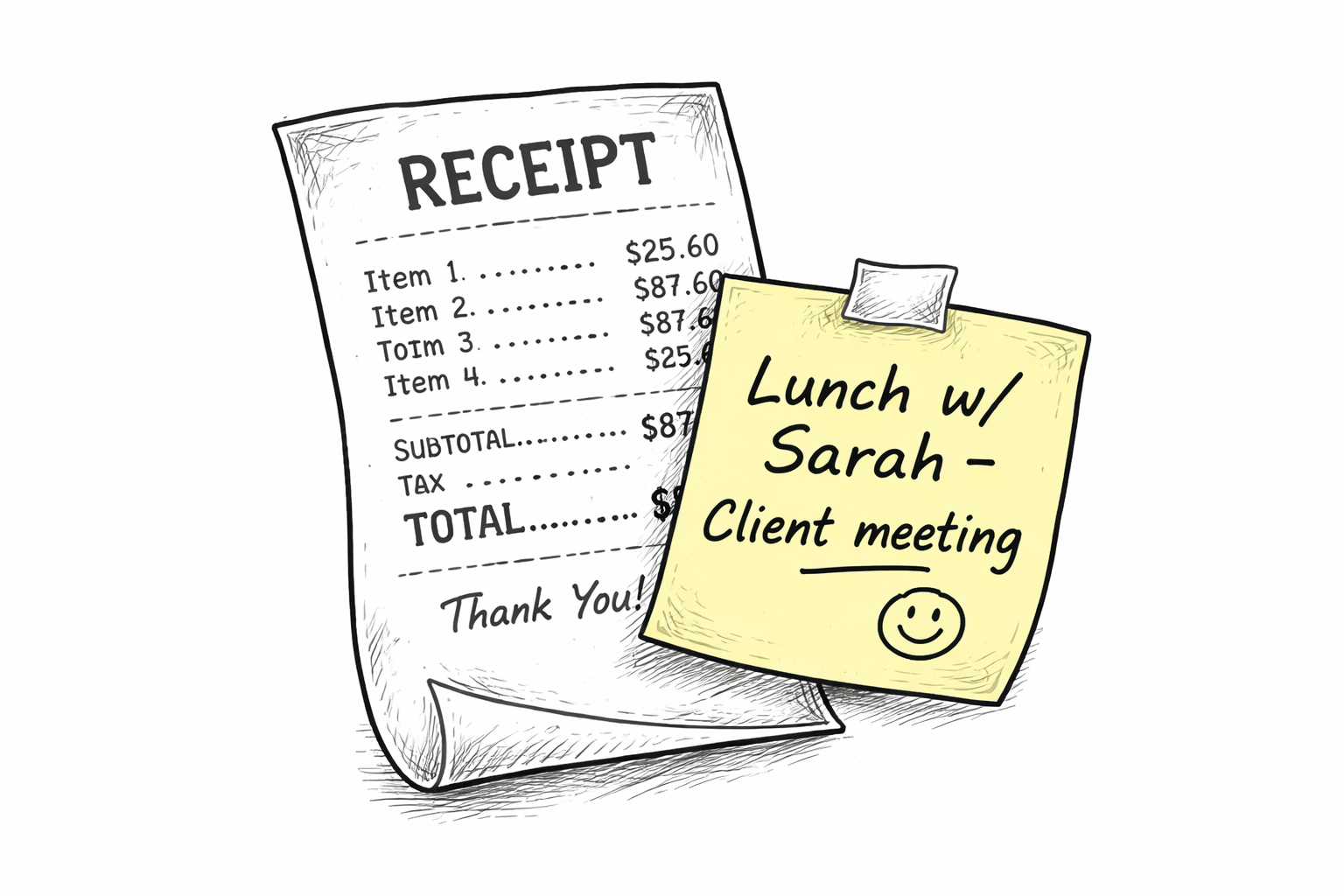
You have the documentation. But do you have the story? Learn why receipts alone aren’t enough.
Daniel was good about saving receipts.
They lived in a folder on his computer.
Some came from email.
Others were snapped on his phone and uploaded later.
If someone asked him whether he had documentation, the answer was almost always yes.
He felt covered.
Organized.
Responsible.
Why This Feels Like Enough
At first glance, it is.
A receipt shows:
the date
the vendor
the amount
It looks complete.
It feels like proof.
So the assumption becomes:
“That should be enough.”
What Receipts Don’t Tell You
Then a question comes up.
And suddenly, the receipt falls short.
It shows what was purchased.
But not why.
It doesn’t explain:
whether it was routine or one-time
whether it was tied to a specific client
whether it was part of a larger decision
or whether it even belongs where it was placed
And now you’re left trying to remember.
This Is Where Things Start Slipping
Because without context:
two identical charges look the same
a meaningful expense looks ordinary
and important distinctions disappear
On paper, everything looks clean.
In reality, the story is missing.
Why This Matters More Than You Think
This is not just about documentation.
It’s about interpretation.
A receipt is evidence.
But evidence doesn’t explain itself.
Someone still has to interpret what it means.
And when that interpretation happens months later…
You’re relying on memory again.
And memory is not reliable when money is involved.
Where the Money Gets Left Behind
This is where the impact shows up.
When something isn’t fully clear:
you hesitate
you second-guess
or you leave it alone
Not because it’s wrong.
Because you can’t confidently explain it.
And if you can’t explain it…
You can’t fully use it.
That’s how money gets left on the table.
What a Simple Note Actually Does
A short note changes everything.
Not a paragraph.
Not an essay.
Just enough to capture intent.
Client meeting – project X
One-time equipment replacement
Travel related to contract Y
Now the transaction has meaning.
Now it can stand on its own.
Now it doesn’t rely on memory.
This Is the Difference
Receipts show that something happened.
Notes explain why it mattered.
And that difference is everything.
Because when numbers are paired with meaning:
they make sense
they hold up
they support your position
Without that…
They’re just numbers.
The Businesses That Feel Different
The businesses that move smoothly through review and filing are not the ones with the most receipts.
They are the ones whose records explain themselves.
No digging.
No guessing.
No reconstruction.
Everything is already there.
What This Means for You
If you’ve been relying on receipts alone, you’re not doing anything wrong.
You’re just stopping halfway.
You’ve captured the evidence.
But not the meaning.
And meaning is what allows your records to work for you.
Adding notes is not extra work.
It’s finishing the job.
The Bottom Line
Receipts prove that something happened.
Notes explain why it matters.
And that explanation is what allows your numbers to stand on their own.
If you want your records to actually support you, your next step is simple:
Start adding notes.
Not to everything.
Start with anything that might not be obvious later.
Because a few words today can save you from uncertainty tomorrow.
And that’s where better, more favorable tax outcomes begin.
Chapter 8: What Tax Preparers Hate Seeing
Back to Table of Contents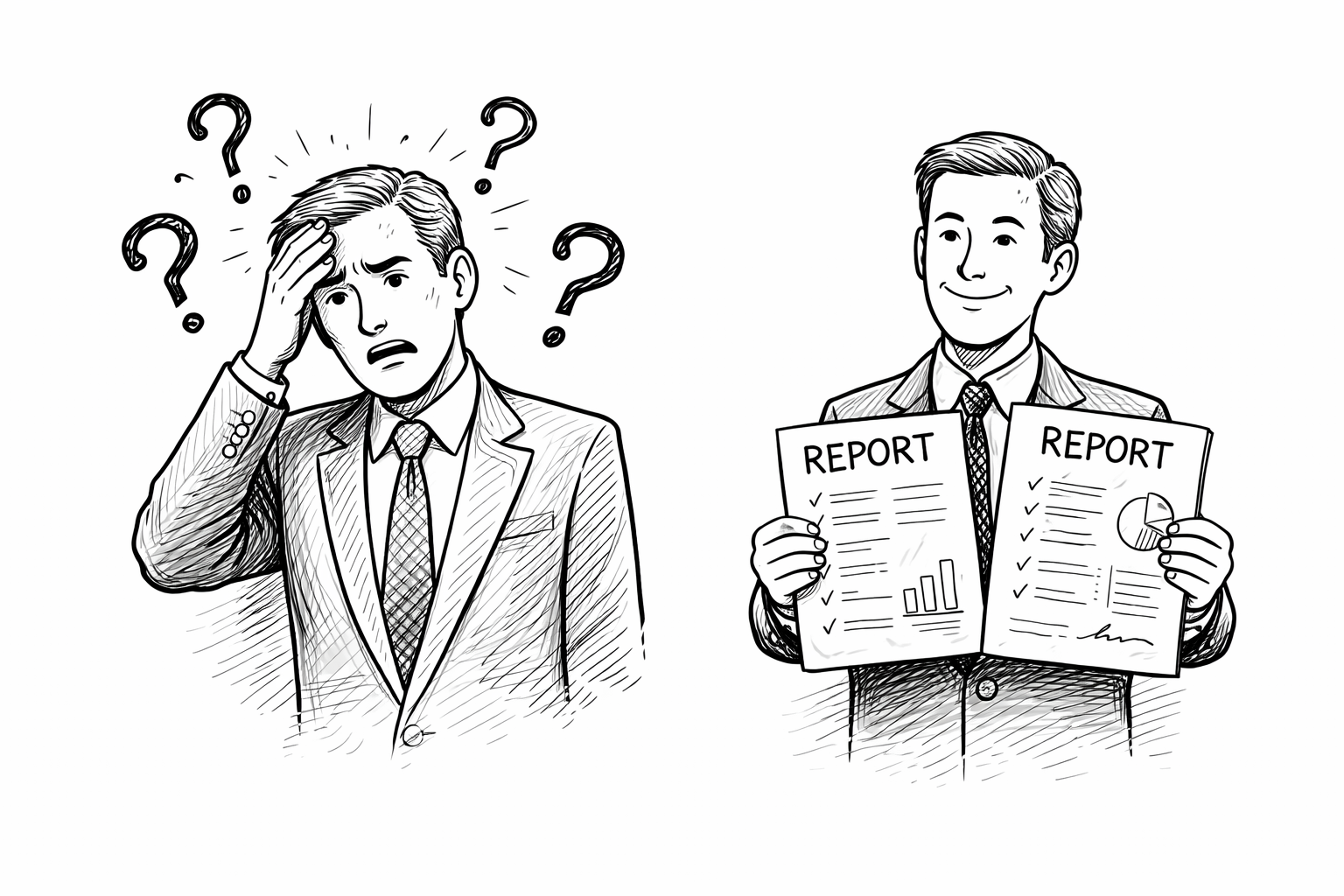
Most business owners think they’re saving money by delaying their books. They’re not. What feels like a shortcut today quietly turns into missed deductions and higher taxes later.
Rachel prided herself on being prepared.
When tax time approached, she sent everything over neatly packaged.
Statements.
Reports.
Spreadsheets.
She felt good hitting “send.”
From her point of view, she had done her part.
Then the Questions Started
At first, it was just one.
Then another.
Then a few more.
Clarifications.
Requests for backup.
Follow-ups that felt… basic.
Rachel didn’t understand.
Everything was there.
So why did it feel like nothing was clear?
Where the Frustration Really Comes From
What most business owners don’t realize is this:
Preparation and usefulness are not the same thing.
You can send everything.
And still make someone work harder to understand it.
Tax preparers don’t struggle with volume.
They struggle with interpretation.
It’s Not Messy People… It’s Messy Stories
They see numbers all day long.
That’s not the problem.
The problem is when those numbers don’t tell a clear story.
When something could mean more than one thing.
When patterns shift without explanation.
When totals add up… but don’t quite make sense.
That’s what slows everything down.
What Happens When Things Aren’t Clear
When a preparer can’t immediately understand what they’re looking at, they have two options:
stop and ask questions
or make safe assumptions
Neither is good for you.
Questions slow everything down.
Assumptions reduce what you could have claimed.
And both increase your cost.
Why This Quietly Costs You Money
This isn’t just about convenience.
It’s about outcomes.
Because when a preparer has to protect themselves:
they take the conservative route
they avoid anything that isn’t clearly supported
they don’t push for better treatment
Not because they don’t want to.
Because they can’t.
And that’s where a lot of money gets left on the table.
What Tax-Ready Books Actually Do
Tax-ready books remove that hesitation.
They don’t just present numbers.
They explain them.
They make intent obvious.
They make patterns easy to follow.
They allow someone to move forward without stopping every few minutes to figure things out.
What Preparers Are Actually Looking For
Not cleverness.
Not complexity.
Not creativity.
Consistency.
They want to see:
that things mean what they say
that patterns repeat logically
that anything unusual stands out clearly
That’s it.
And when that’s there…
Everything changes.
When Your Books Start Working for You
The back-and-forth disappears.
The questions drop off.
The process speeds up.
And something else happens that most people don’t expect.
Trust increases.
When your records make sense, people rely on them.
And when people rely on them…
Better decisions get made.
Decisions that favor YOU.
Where Most Businesses Get Stuck
The fastest way to frustrate a tax preparer is to hand them records that look organized…
But require interpretation.
Because now they’re not just preparing your taxes.
They’re decoding your thinking.
And that’s not their job.
What This Means for You
If your tax season always turns into a series of emails, questions, and clarifications…
This is why.
It’s not a lack of effort.
It’s not a lack of information.
It’s a lack of clarity in how that information is presented.
The Bottom Line
Books that create questions slow everything down.
Books that answer them move everything forward.
If you want a smoother, faster, and more favorable tax process, your next step is simple:
Make your records explain themselves.
Because when they do…
Everything gets easier.
And the outcome improves right along with it.
Not a “conservative” outcome done for the sake of playing it “safe.”
But a confident one that keeps more of your tax dollars safely in your pocket.
Chapter 9: Why Clean Books Cost Less in the Long Run
Back to Table of Contents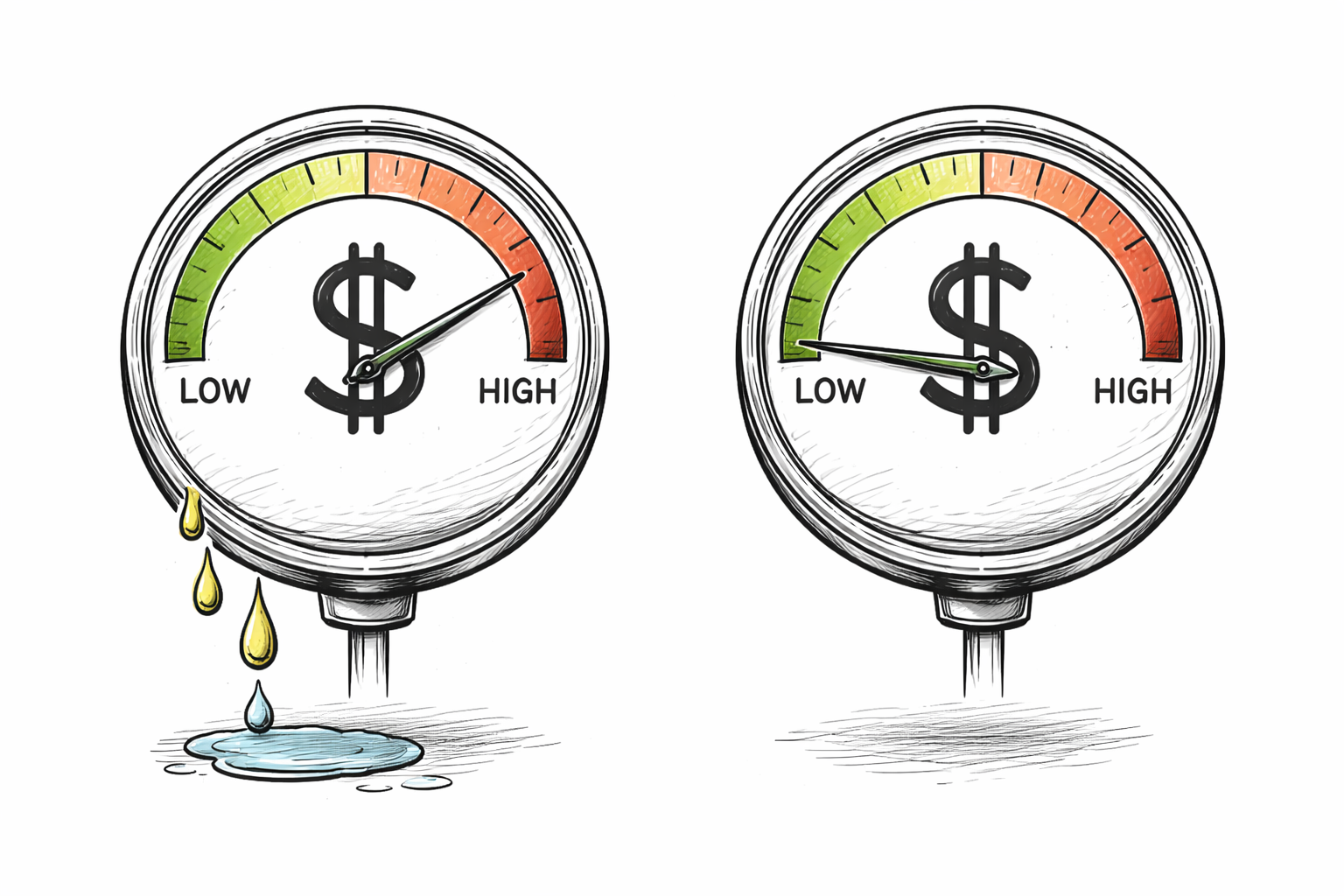
Putting things off does not just create more work later. It costs you real money. The longer clarity is delayed, the more opportunities quietly disappear.
Mark thought he was saving money.
That was the story he told himself.
Skip the monthly work.
Deal with it later.
Keep more cash in the business now.
Simple.
Practical.
Smart.
At least, that’s how it felt.
Where the Real Cost Hides
What Mark didn’t see was this:
The biggest cost wasn’t the cleanup.
It was what never got captured.
Because when everything is left until later…
Details disappear.
Intent gets lost.
And small decisions that could have mattered…
Never get made.
What Gets Missed
When books are reconstructed after the fact:
expenses lose their context
legitimate deductions become unclear
and opportunities quietly disappear
Not because they weren’t there.
Because they weren’t captured properly when they happened.
Why This Leads to Higher Taxes
This is the part most business owners never see.
When something isn’t clearly supported…
It doesn’t get used.
Or it gets treated conservatively.
Either way…
You pay more than you should.
Not because the system is unfair.
Because your records didn’t support a better outcome.
The Illusion of “Saving Money”
Mark wasn’t saving money.
He was delaying visibility.
And when visibility disappears…
So do options.
So do deductions.
So do opportunities to reduce what you owe.
And Then Comes the Cleanup
Yes, the cleanup costs more.
More time.
More questions.
More back-and-forth.
But even after all that…
You don’t fully recover what was lost.
Because you can’t recreate clarity after the fact.
The Part That Bites You… Hard
You can fix messy books.
You can pay for cleanup.
You can answer questions.
But you can’t go back and capture what wasn’t recorded properly in the moment.
That opportunity is gone.
What Clean Books Actually Do
Clean books don’t just organize your numbers.
They preserve opportunity.
They capture intent while it’s still clear.
They make sure nothing valuable gets lost in the process.
And that’s what changes the outcome.
The Cost No One Sees Coming
There’s also the mental side.
Messy books linger.
They create uncertainty.
They sit in the background, unfinished.
You think about them more than you want to.
You avoid them more than you should.
And when tax time comes…
You brace for it.
The Shift That Changes Everything
At some point, the question changes.
From:
“What’s the cheapest way to handle this?”
To:
“What’s the smartest way to make sure I don’t lose money?”
That’s the turning point.
What This Means for You
If you’ve been putting this off to save money…
You’re not alone.
But now you see the tradeoff.
You’re not just postponing the work.
You’re risking the outcome.
And the outcome is where the real money is.
The Bottom Line
Messy books don’t just cost more to fix.
They cost you in missed deductions.
Missed opportunities.
And higher taxes than you should be paying.
Clean books don’t just save time.
They protect what’s yours.
And THAT’S where the real savings show up.
Chapter 10: The Difference Between Records and Guidance
Back to Table of Contents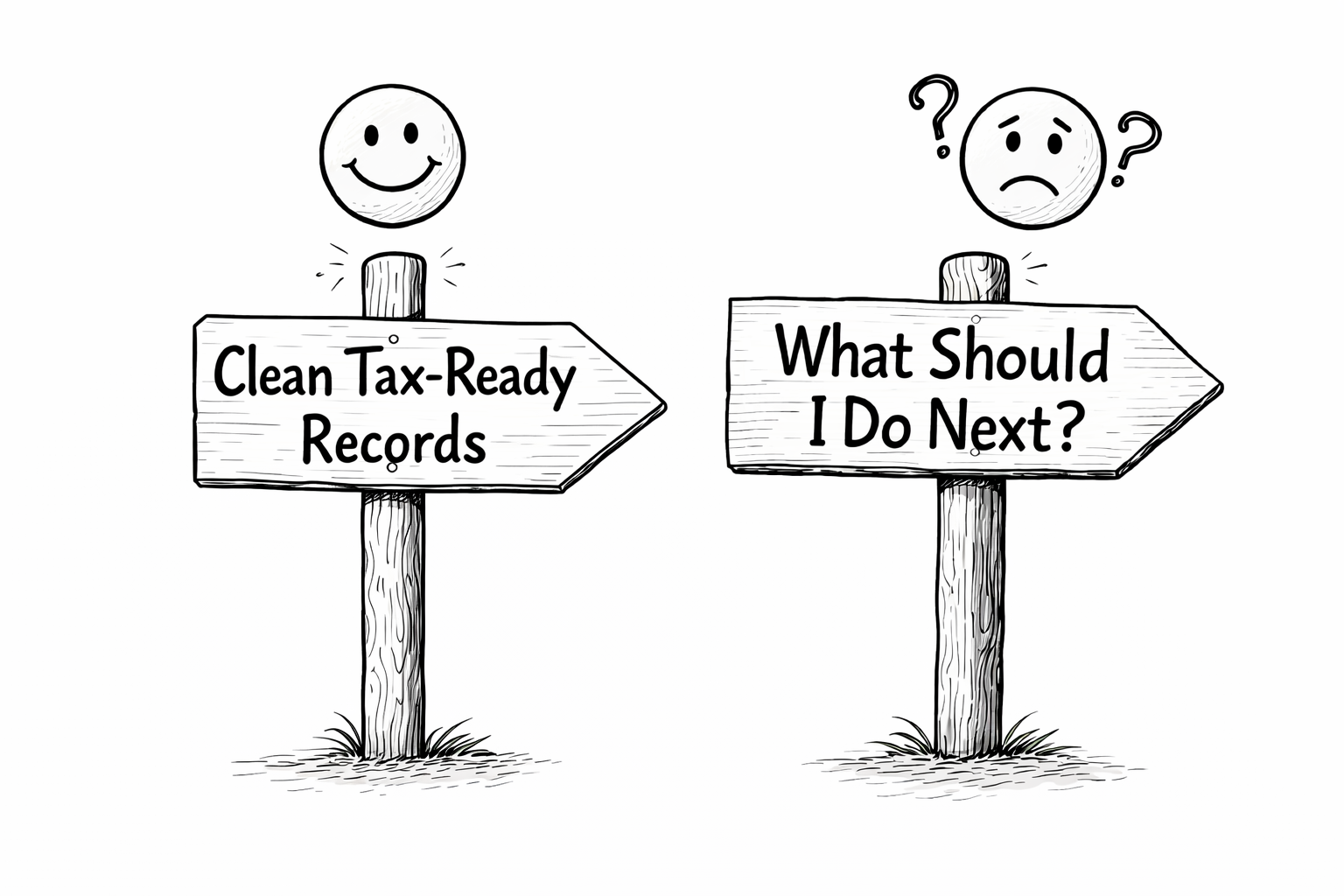
Clean records alone are not enough. Without the right kind of guidance, decisions get made without direction and money gets left on the table.
Tom wanted to know he was doing things right.
Not just recorded.
Right.
When it came to money, especially around tax time, he didn’t just want numbers.
He wanted direction.
So he asked questions.
What should this be.
Is this the best way to handle that.
Would it be smarter if I did something differently next time.
And those questions matter.
Because they don’t just affect your records.
They affect your outcome.
What Most Business Owners Assume
From Tom’s point of view, it seemed obvious.
Someone working on his books sees everything.
They understand the flow.
They know what’s happening.
So naturally.
They would help him make better decisions.
What He Was Actually Getting
But that’s not always what happens.
Sometimes, what you’re getting is only the record.
A clean picture of the past.
But no real direction for the future.
Why That Leaves Money on the Table
Because decisions don’t optimize themselves.
If no one is actively guiding how things are handled:
expenses get recorded, but not maximized
transactions get categorized, but not positioned
opportunities exist, but are never captured
Not because they aren’t available.
Because no one is structuring things to take advantage of them.
The Two Types of Guidance
This is where everything changes.
Not all guidance is the same.
Some guidance is conservative.
It focuses on being safe.
It avoids risk.
It defaults to what is obvious and easily supported.
And while that feels secure.
It often leads to paying more than necessary.
Then There Is Intentional Guidance
The kind that looks deeper.
The kind that understands how to structure things properly.
The kind that makes sure every legitimate opportunity is captured.
Not forced.
Not stretched.
Captured.
Because it was recognized and supported properly from the beginning.
And That Difference Shows Up in One Place
Your tax outcome.
One approach keeps things acceptable.
The other makes sure nothing gets left behind.
Records Do Matter
None of this works without strong records.
Records are the foundation.
They make everything visible.
They make everything supportable.
They make everything defensible.
Without that.
Even the best guidance falls apart.
But Records Alone Are Not Enough
This is the part most people miss.
You can have clean books.
And still miss opportunities.
Because clean does not automatically mean optimized.
What This Means for You
If your current system is only focused on keeping things organized.
You may be doing everything right.
And still not getting the best result.
Not because you made mistakes.
Because no one is guiding the outcome.
The Bottom Line
Records show you what happened.
Guidance determines what you do with it.
And how you do it next time… and the next.
If that guidance is missing.
Or overly conservative.
You will almost always pay more than you should.
The goal is not just to have books that “look” good.
It is to make sure those books are working for you.
Making sure no legitimate opportunities are missed when it come to your final tax bill.
Chapter 11: When “Smart” Moves Bite You Back
Back to Table of Contents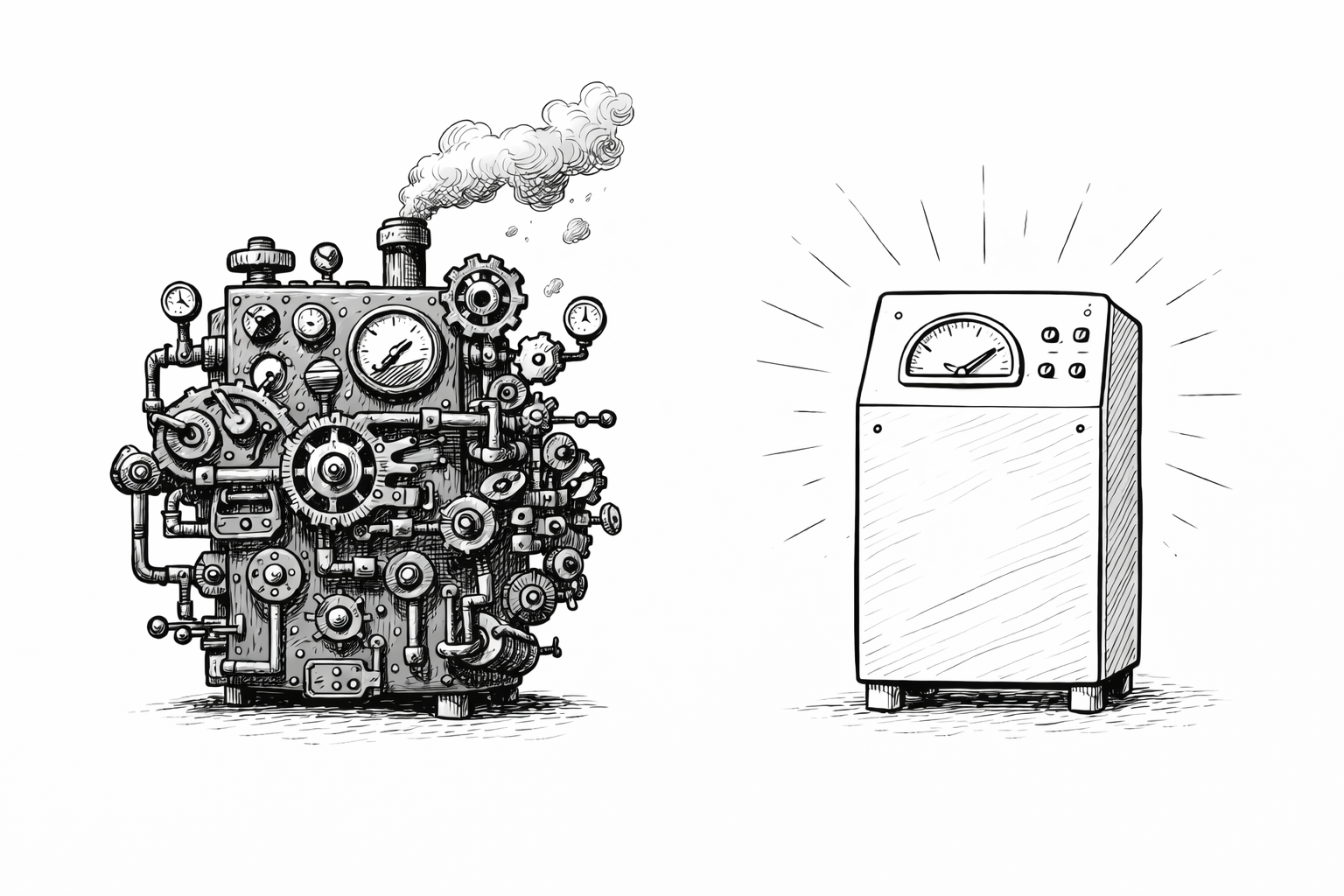
Trying to be clever with your books often backfires. When records need explaining, confidence drops and opportunities disappear.
Ethan liked to be smart about how he tracked his business transactions.
He paid attention.
Read articles.
Watched videos.
Picked up ideas from other business owners.
Every tip promised the same thing.
A better result.
A smarter move.
A way to pay less.
And none of it sounded wrong.
In fact, most of it sounded quite clever.
So He Started Tweaking Things
A small adjustment here.
A different way of labeling something there.
A category that felt a little more advantageous.
Nothing extreme.
Nothing obvious.
Just small moves designed to improve the outcome.
At first, it felt like progress.
Then Something Changed
Over time, things started to feel less solid.
Not wrong.
Just harder to stand behind.
Because the books were no longer just recording what happened.
They were trying to shape what it looked like happened.
And that is where the shift begins.
The Problem With “Clever” Optimization
Most bad optimization does not just bend rules.
It bends reality.
It turns clear records into something that needs explaining.
Something that depends on memory.
Something that only makes sense if you were there when the decision was made.
And That Creates a New Risk
Because now your numbers do not stand on their own.
They need support.
They need context.
They need defense.
And the moment that happens.
Confidence drops.
What Happens When Confidence Drops
When records feel engineered instead of natural:
professionals slow down
they double check everything
they assume conservatively, erring on the side of caution
they avoid anything that feels uncertain
And just like that.
The advantage you were trying to create disappears.
Why This Still Leads to Higher Taxes
This is the part most people miss.
Trying to be too clever does not just create risk.
It often leads to worse outcomes.
Because anything that feels questionable gets treated cautiously.
And cautious treatment means:
less claimed
less used
less benefit
So in the end.
You do not win more.
You lose what you already had.
The Difference Between Real and Fake Optimization
Real optimization is built into the structure.
It comes from:
clear records
consistent handling
properly captured intent
It does not need defending.
It is obvious.
It is supported.
It holds up on its own.
Fake Optimization Tries to Force the Outcome
It adjusts things after the fact.
It relies on interpretation.
It depends on how something is explained.
And that is where it breaks.
Because explanations do not scale.
Structure does.
What Actually Works
The strongest businesses do not chase every angle.
They build systems that capture everything properly the first time.
They do not force better outcomes.
They allow them.
Because everything is already aligned.
What This Means for You
If you have ever tried to be a little smarter with how something was handled.
You are not alone.
But now you see the difference.
There is a line between capturing opportunity.
And trying to manufacture it.
One strengthens your position.
The other weakens it.
The Bottom Line
Clever books need defending.
Strong books defend themselves.
If your records rely primarily on explanation, you are already at a disadvantage.
The goal is not to be clever.
It’s not easy keeping that up.
Clarity and consistency beat clever every time.
And you don’t lose sleep over the supportability of your records.
And better tax outcomes?
That’s a given.
Chapter 12: Why the Clarity of Your Books Dramatically Increases the Value of Your Business
Back to Table of Contents
Clear books do more than help at tax time. They increase the value of your business, attract opportunity, and give you options most owners never realize they have.
Most business owners see their books as something they have to do.
Something required.
Something defensive.
Something tied to compliance and deadlines.
Very few see them for what they really are.
A window.
Clear books let you see your business as it actually is, not as you hope it might be.
And once that window is clean, everything changes.
Growth becomes clearer.
Decisions become easier.
And the value of your business becomes easier to see, explain, and transfer.
This is where tax-ready thinking becomes value-ready thinking.
Clear Books Help You Allocate Resources Smarter and Grow Faster
Jason ran a profitable business.
At least, that’s what it looked like.
Money came in steadily.
Revenue was growing.
Expenses seemed reasonable.
On paper, everything looked fine.
But it didn’t feel that way.
Cash felt tight.
Some months were exhausting.
Others felt strangely unproductive.
The problem wasn’t effort.
It was visibility.
His books showed what happened.
But not where the business was actually winning or quietly losing.
Categories were too broad.
Patterns were buried.
He couldn’t clearly see which services were driving profit and which were draining time and energy.
Then something changed.
His books became clear.
And suddenly, the answers were obvious.
Where margins were strongest.
Which clients were most profitable.
Which services were not worth the effort.
Jason didn’t work harder.
He worked smarter.
He redirected time, money, and focus.
Growth accelerated.
Not because he pushed more.
Because he stopped wasting effort where it wasn’t paying off.
Clear books turned guesswork into strategy.
Clear Books Attract Investors and Create Competition
Sophia wasn’t looking for investment.
Investment found her.
A potential investor noticed her steady growth and reached out.
At first, it was casual.
Then it became serious.
Questions followed.
Not about ideas.
About numbers.
This is where most opportunities fall apart.
Investors don’t invest in enthusiasm.
They invest in understanding.
Sophia’s advantage wasn’t perfection.
It was clarity.
Revenue made sense.
Expenses were consistent.
Trends were easy to follow.
Nothing needed explaining.
Nothing needed defending.
And that changed everything.
More investors became interested.
Because the books were clear, the focus stayed on opportunity, not cleanup.
Confidence increased.
So did demand.
Sophia didn’t chase capital.
She chose it.
Clarity didn’t just attract opportunity.
It created competition for it.
Clear Books Make a Business Easier to Sell and More Valuable
Mark never planned to sell his business.
Until one day, he did.
An unexpected opportunity came up, and everything shifted.
Now it wasn’t about running the business.
It was about proving its value.
And this is where most businesses struggle.
Buyers don’t buy stories.
They buy systems.
They want to see how the business works without the owner explaining every detail.
They look for consistency.
Predictability.
Proof that the business can stand on its own.
Mark’s books told that story.
Clearly.
Revenue patterns were obvious.
Expenses were stable.
Nothing felt improvised.
Due diligence moved quickly.
There was nothing to untangle.
And when the offer came.
It was higher than expected.
Not because the business changed.
Because the risk was lower.
Clarity increases confidence.
And confidence increases value.
Clear books didn’t just make the sale possible.
They made it smoother, faster, and more favorable.
The Bigger Picture
Tax-ready books are often treated as the finish line.
They are not.
They are the foundation.
They support better decisions today.
Stronger positioning tomorrow.
And real leverage when opportunity shows up.
They turn a business from a job into an asset.
From effort into equity.
You may never look for investors.
You may never plan to sell.
But businesses with clear books always have more options than those without.
And options are what create value.
The Bottom Line
Clear books do more than help you file.
They help you grow, attract opportunity, and increase what your business is worth.
And when that day comes.
You are ready.
Chapter 13: What Consistency Really Looks Like
Back to Table of Contents
Inconsistency does not fail loudly. It costs you quietly. Small differences in how things are handled lead to missed opportunities and higher taxes over time.
Most business owners think consistency means discipline.
Doing everything perfectly.
Staying on top of it at all times.
Never falling behind.
That sounds good.
Until real life shows up.
Where This Starts Breaking Down
Nina tried to be consistent.
She blocked time each month.
Promised herself she would stay on top of things.
Meant it every time.
Some months worked.
Others didn’t.
Work got busy.
Life got in the way.
A few days slipped by.
Then a few more.
And before long.
She was behind again.
The Real Problem
Nina wasn’t failing.
She was aiming at the wrong target.
Because consistency is not about perfection.
It’s about repeatability.
Why This Matters More Than It Seems
When your system depends on motivation.
It eventually breaks.
When it breaks:
things get delayed
decisions get rushed
details get missed
And when details get missed.
So do opportunities.
How Inconsistency Costs You Money
This is where the impact shows up.
Not all at once.
Quietly.
Over time.
Because when your approach keeps changing:
categories shift
logic changes
similar transactions get handled differently
And that creates something dangerous.
Uncertainty.
What Uncertainty Leads To
When your records are inconsistent:
patterns become harder to trust
trends become harder to see
and decisions become less reliable
And when something is not clear.
It gets treated cautiously.
Which means:
less claimed
less used
less benefit
And once again.
You pay more than you should.
Why Most Businesses Don’t Notice This
Inconsistent books don’t break.
They drift.
Everything still looks fine.
Nothing stands out as obviously wrong.
But over time.
The numbers stop telling a clear story.
And when that happens.
You lose the ability to act with confidence.
What Real Consistency Looks Like
Consistency is not intense.
It’s simple.
It looks like:
using the same categories the same way
handling similar transactions similarly
keeping the system stable over time
No constant tweaking.
No reinventing the wheel.
Just a structure that holds.
What Changes When You Get This Right
Nina didn’t become more disciplined.
She became more predictable.
Her system became simple enough to repeat.
And once that happened.
Everything settled down.
No more starting over.
No more second guessing.
No more drift.
The books stopped depending on effort.
And started working on their own.
The Real Secret
Consistency is not a personality trait.
It’s a system.
A system that works when you’re busy.
A system that works when things are messy.
A system that works even when you don’t feel like it.
That’s what makes it powerful.
What This Means for You
If your current approach relies on staying on top of it.
You’re setting yourself up for frustration.
Not because you lack discipline.
Because the system itself isn’t built to last.
Fix the system.
And consistency follows.
The Bottom Line
Inconsistent books don’t fail loudly.
They cost you quietly.
Consistent books create clarity.
And clarity leads to better, more favorable tax outcomes.
Chapter 14: The Year-End Scramble
Back to Table of Contents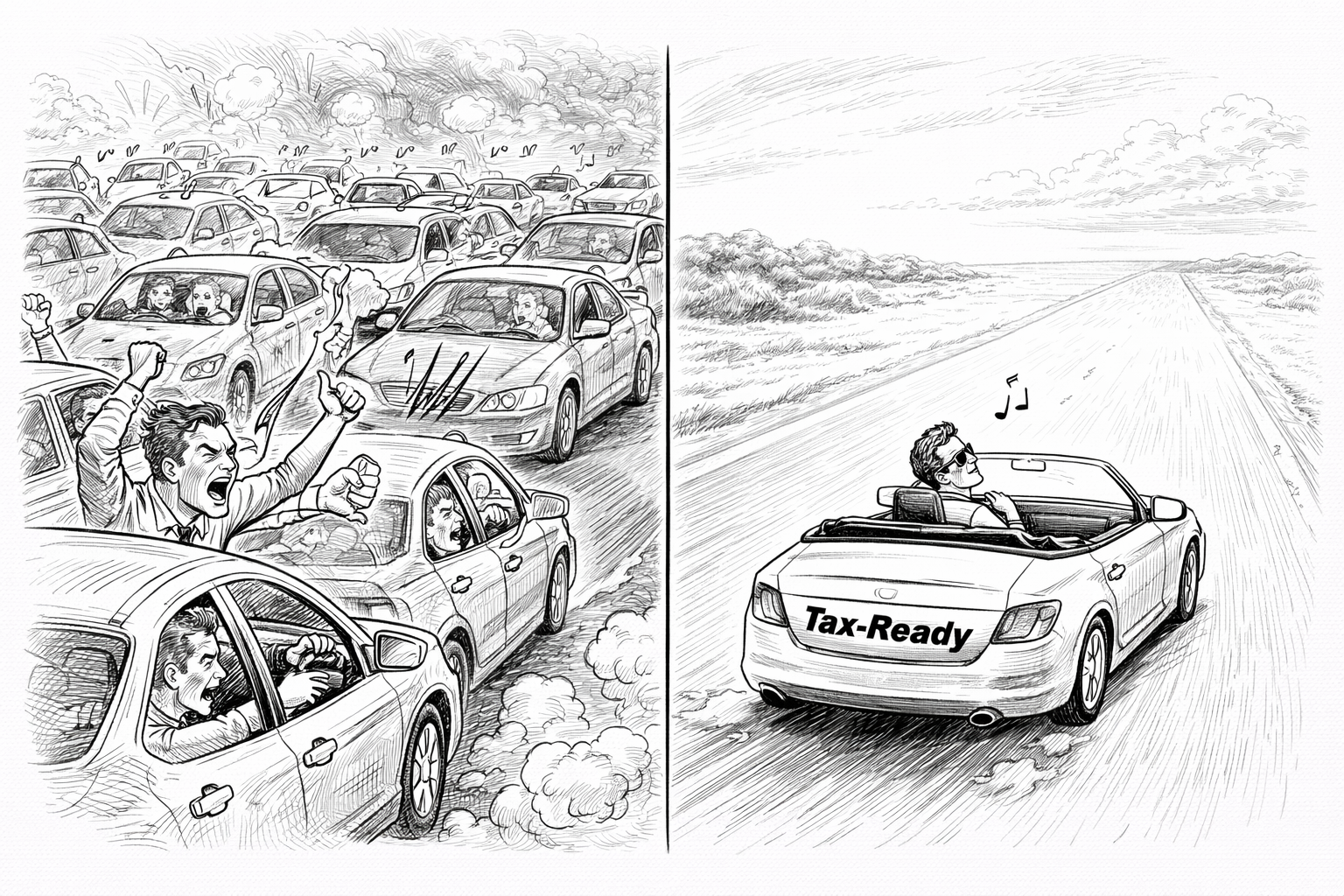
The year-end scramble is not normal. It is the result of small delays that build into pressure, stress, and missed opportunities when it matters most.
As his year-end approached, Mario told himself the same thing.
“This year will be different.”
He meant it.
The business had done well.
Most months were reasonably up to date.
Nothing felt completely out of control.
Compared to past years, this one even felt better.
And still.
As year-end drew closer, the tension came back.
How the Pressure Starts Building
It wasn’t one big disaster.
It was a pile of small unfinished things.
Missing notes.
Transactions that had been postponed.
Loose ends that had been easy to ignore in the moment.
Now they all wanted attention at once.
And that’s what made year-end feel heavy.
Why This Hits So Hard
The final stretch of the year was already demanding.
Long days.
Tight deadlines.
Less sleep.
Mario was already carrying enough.
The unfinished books made it worse.
Not just mentally.
Physically.
He felt it in his shoulders.
In his sleep.
In the low-grade anxiety that followed him home at night.
Even when the workday ended.
His mind didn’t.
This Is How Stress Quietly Compounds
Year-end stress is rarely dramatic.
It builds.
One deferred decision becomes two.
One unanswered question becomes five.
One month left unchecked quietly turns into a quarter.
Then suddenly it’s year-end.
And everything feels heavier than it should.
Why the Scramble Costs More Than Time
This is not just about feeling stressed.
It affects judgment.
It affects energy.
It affects what gets missed.
And when you’re tired, rushed, and trying to close gaps all at once.
You do not make your best decisions.
That is when things get overlooked.
That is when support gets missed.
That is when legitimate deductions slip away.
And once again.
You pay more than you should.
The Lie Most Business Owners Believe
Most business owners think the year-end scramble is just part of running a business.
It isn’t.
It is not inevitable.
It is the result of postponed clarity.
It happens when decisions are delayed instead of made while the information is fresh.
It happens when questions are ignored instead of flagged early.
It happens when the system depends on memory instead of rhythm.
No matter when your year ends, the pattern is the same.
What Tax-Ready Businesses Do Differently
Tax-ready businesses do not aim for perfection.
They aim for closure.
They build small, repeatable check-ins into the year.
They deal with things while they are still easy to understand.
They catch problems early, when the fix is simple.
And that changes everything.
What Year-End Starts Feeling Like
When the system works, year-end feels different.
You are not reconstructing the year.
You are reviewing it.
You are not rushing to fix problems.
You are confirming what already makes sense.
That is a completely different experience.
What This Means for You
If year-end always feels heavier than it should.
If the closing stretch brings pressure, unfinished business, and that familiar knot in your stomach.
That is not just how it is.
It is a sign that your system is making things harder than they need to be.
And that can be fixed.
The Bottom Line
The year-end scramble is not caused by one big mistake.
It is caused by small delays that pile up over time.
Tax-ready books drain that stress all year long.
And when year-end arrives.
You are ready, not rattled.
Chapter 15: A Simple Tax-Ready Checklist
Back to Table of Contents
Tax-ready is not complicated. A small number of consistent actions, done the right way, protect what is yours and lead to better outcomes.
After everything you’ve seen so far, one question naturally comes up.
What does this actually look like day to day?
Not in theory.
Not in perfect conditions.
But in the real world, where you’re busy and time is limited.
The Answer Is Simpler Than You Think
Tax-ready systems are not built on complexity.
They are built on a handful of actions that work together quietly in the background.
Nothing dramatic.
Nothing overwhelming.
But when they’re done consistently.
Everything changes.
Where Most People Get Stuck
Emma ran a growing service business.
Nothing was ever completely out of control.
But nothing ever felt finished either.
She was always a little behind.
Always a little unsure.
Always carrying it in the back of her mind.
Every few months, she told herself the same thing.
“I need a better system.”
What Finally Made the Difference
It wasn’t a new tool.
It wasn’t more effort.
It was a short list.
Once she focused on doing a few things consistently.
The noise faded.
The books stopped feeling heavy.
And something else happened.
She stopped second-guessing everything.
The Checklist That Changes Everything
This is what that system looked like:
separate business and personal accounts where possible
use the same categories the same way every month
record transactions regularly instead of all at once
add short notes when intent is not obvious
save receipts in a way you can actually find later
flag questions instead of guessing
close each month before moving on
Why This Works
None of these steps are complicated.
That’s the point.
They work because they are repeatable.
They work because they hold up during busy weeks.
They work because they don’t depend on motivation.
What This Protects
When this checklist becomes part of your system:
details don’t get lost
decisions don’t get rushed
opportunities don’t get missed
And that leads to one thing.
Better outcomes.
What This Feels Like Over Time
Emma didn’t become more organized overnight.
She became more intentional.
The system took over where effort used to be required.
And over time.
Everything settled down.
The books felt stable.
The questions dropped off.
The pressure disappeared.
What Tax Time Turns Into
Tax time stopped feeling like a judgment day.
It became a confirmation.
A review of what already made sense.
No scrambling.
No second-guessing.
No surprises.
The Bottom Line
Tax-ready is not complicated.
It is consistent.
Do the right few things.
Do them the same way.
And do them often enough that nothing gets left behind.
And when that happens.
Better, more favorable tax outcomes follow.
Chapter 16: What to Do Next (And Who Does What)
Back to Table of Contents
Clarity, consistency, and the right roles change everything. When your system works, your books stop creating problems and start producing results.
By now, one thing should be clear.
Tax-ready books are not something you do once.
They are how you operate.
They don’t depend on perfect timing.
They don’t depend on perfect memory.
They depend on clarity.
Consistency.
And knowing exactly who is responsible for what.
That last part matters more than most people realize.
What You Own
As a business owner, you own the story.
You know why money moved the way it did.
You know what was routine.
What was unusual.
What was intentional.
And what was a one-time decision.
That context lives with you.
And if it’s not captured.
It disappears.
That’s where money gets lost.
That’s where opportunities fade.
Your role is not to become a tax expert.
Your role is to make sure your records reflect reality clearly and consistently.
When that happens.
Everything downstream improves.
What Your System Should Be Doing
A strong bookkeeping system does one thing well.
It records what actually happened.
Clearly.
Consistently.
Without guessing.
Without trying to be clever.
Without trying to force an outcome.
When your system is working properly.
Your books explain themselves.
No backtracking.
No second-guessing.
No reconstruction.
That is the standard.
What Tax Professionals Actually Do
Tax professionals don’t create your story.
They interpret it.
They take what you’ve recorded and apply rules, judgment, and experience.
But their work is only as strong as the information they receive.
If your records are unclear.
They have to slow down.
They have to question.
They have to default to caution.
And when that happens.
You lose ground.
Not because the opportunity wasn’t there.
Because it wasn’t clearly supported.
Why This Changes Everything
When each part is doing its job:
your records are clear
your system is consistent
your information is usable
And now.
Everything works together.
Decisions get better.
Opportunities become visible.
And your tax outcome improves.
What Your Next Step Looks Like
You don’t need to overhaul everything overnight.
You start with better choices.
Small ones.
Repeatable ones.
Choose clarity over convenience.
Choose notes over guessing.
Choose consistency over trying to be clever.
Those decisions compound.
What This Turns Into Over Time
At first, it feels like effort.
Then it becomes routine.
Then it becomes normal.
And eventually.
It becomes quiet.
Tax season stops feeling like pressure.
Conversations become easier.
Confidence replaces uncertainty.
And something important happens.
You stop wondering if you’re doing it right.
The Bottom Line
You don’t need tricks.
You don’t need shortcuts.
You need a system that works.
One where:
you capture the story
your books reflect it clearly
and everything that follows builds on that foundation
That’s what tax-ready really offers.
Clarity.
Confidence.
And control over outcomes that used to feel uncertain.
If you’ve seen yourself in these pages.
If you recognize the patterns, the pressure, or the missed opportunities.
Then you already know what needs to change.
You don’t have to figure it out alone.
At Tax Ready Ledger Co, this is exactly what we do.
We help business owners build tax-ready systems that don’t just organize their books.
These books in turn, protect what’s yours.